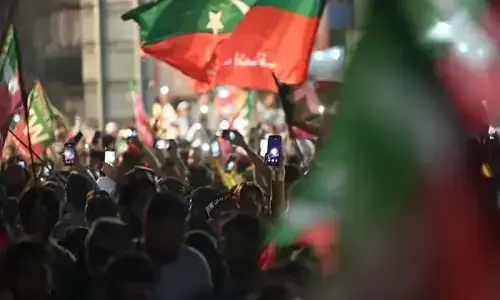
SWAT: Doctors, nurses, paramedics, civil society activists and members of various political parties held a sit-in outside Saidu Teaching Hospital to denounce the provincial government’s decision to bring the hospital under Medical Teaching Institution (MTI) Act.
Protesters chanted slogans against what they called commercialisation of healthcare and said that such a move would deprive underprivileged of access to affordable medical treatment. They demanded immediate withdrawal of the decision and preservation of the hospital’s public service status.
The protest was addressed by Traders Federation president Abdul Rahim, Wajid Ali Khan, Dr Murad, Dr Khalid Mehmood, Dr Khwaja Irfan, Dr Abdul Munim, Fazal Subhan, Azizul Haq, Akhtar Hussain, Mian Syed Naeem, Iftikhar Afzal, Irshad Ali Khan and Mohammad Ijaz Khan.
They said that Saidu Teaching Hospital, established during the reign of the Wali of Swat, was not just a medical institution but a symbol of history of the region and service to humanity.
They said that the implementation of MTI law would transform the hospital into a semi-autonomous, profit-driven institution, where treatment of poor patients would become increasingly difficult and expensive.
“All political parties in Swat, except Pakistan Tehreek-i-Insaf, have unanimously rejected the government’s decision. We are united in our stand against this move and will resist it at all levels,” said a speaker.
Speakers announced to launch a region-wide protest movement after Eidul Azha, mobilising people from all walks of life. They also criticised elected representatives of Swat for their failure to voice the concerns of locals. They said that continued silence or complicity would be seen as betrayal.
“If local lawmakers are truly committed to public welfare, they should first focus on making operational the district headquarters hospital, which remains under-resourced and underperforming,” they said.
Civil society representatives expressed fears that MTI status of the hospital would encourage outsourcing and contractual employment, leading to job insecurity for medical staff and weakening of healthcare standards.
They demanded of the government to retain the hospital’s existing status and ensure that public healthcare remained accessible, inclusive and non-commercial.
The protest concluded with a warning that failure to reverse the decision would lead to widespread demonstrations across the region following Eid.
Published in Dawn, June 5th, 2025