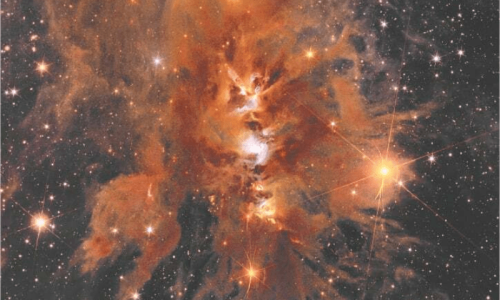
Astronomers scrutinise a star behaving unlike any other


 0
0


WASHINGTON: Astronomers have spotted a star acting unlike any other ever observed as it unleashes a curious combination of radio waves and X-rays, pegging it as an exotic member of a class of celestial objects first identified only three years ago.
It is located in the Milky Way galaxy about 15,000 light-years from Earth in the direction of the constellation Scutum, flashing every 44 minutes in both radio waves and X-ray emissions. A light-year is the distance light travels in a year, 5.9 trillion miles (9.5 trillion km).
The researchers said it belongs to a class of objects called “long-period radio transients,” known for bright bursts of radio waves that appear every few minutes to several hours. This is much longer than the rapid pulses in radio waves typically detected from pulsars — a type of speedily rotating neutron star, the dense collapsed core of a massive star after its death.
Pulsars appear, as viewed from Earth, to be blinking on and off on timescales of milliseconds to seconds. “What these objects are and how they generate their unusual signals remain a mystery,” said astronomer Ziteng Wang of Curtin University in Australia, lead author of the study published this week in the journal Nature.
In the new study, the researchers used data from Nasa’s orbiting Chandra X-ray Observatory, the ASKAP telescope in Australia and other telescopes. While the emission of radio waves from the newly identified object is similar to the approximately 10 other known examples of this class, it is the only one sending out X-rays, according to astrophysicist and study co-author Nanda Rea of the Institute of Space Sciences in Barcelona.
The researchers have some hypotheses about the nature of this star. They said it may be a magnetar, a spinning neutron star with an extreme magnetic field, or perhaps a white dwarf, a highly compact stellar ember, with a close and quick orbit around a small companion star in what is called a binary system.
“However, neither of them could explain all observational features we saw,” Wang said. Stars with up to eight times the mass of our sun appear destined to end up as a white dwarf. They eventually burn up all the hydrogen they use as fuel. Gravity then causes them to collapse and blow off their outer layers in a “red giant” stage, eventually leaving behind a compact core roughly the diameter of Earth — the white dwarf.
The observed radio waves potentially could have been generated by the interaction between the white dwarf and the hypothesised companion star, the researchers said.
“The radio brightness of the object varies a lot. We saw no radio emission from the object before November 2023. And in February 2024, we saw it became extremely bright. Fewer than 30 objects in the sky have ever reached such brightness in radio waves. Remarkably, at the same time, we also detected X-ray pulses from the object. We can still detect it in radio, but much fainter,” Wang said. Wang said it is thrilling to see a new type of behavior for stars.
“The X-ray detection came from Nasa’s Chandra space telescope. That part was a lucky break. The telescope was actually pointing at something else, but just happened to catch the source during its ‘crazy’ bright phase.
Published in Dawn, May 30th, 2025