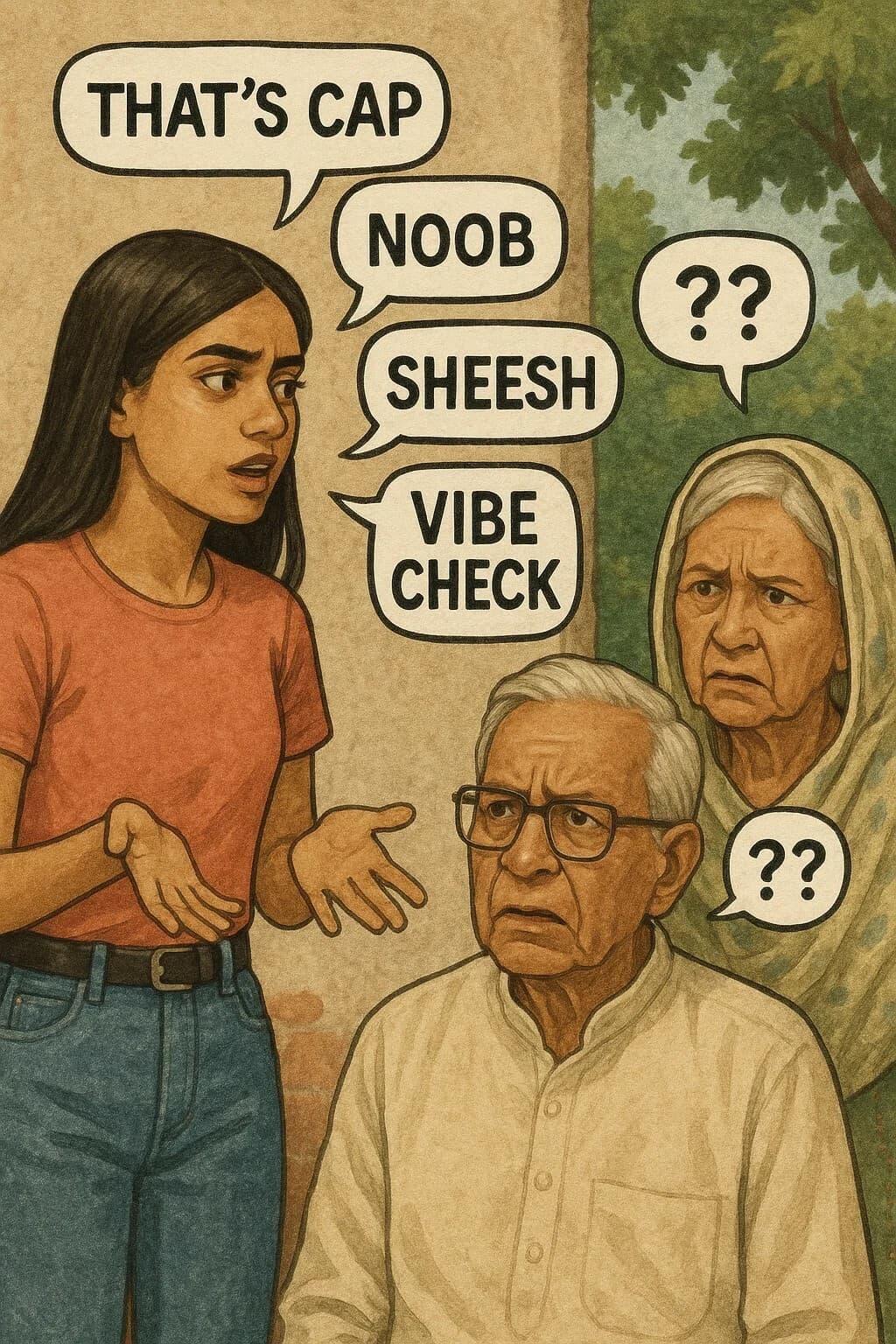
GEN Z has its own flair for the English language. If you happen to be around Gen Z kids, you will immediately notice a difference in their language. Their conversation is usually drenched with words emerging from social media trends. The Boomers and the Millennials — who are not in touch with the ever shifting trends of social media — would often look at it with wonder and some confusion.
Phrases like ‘no cap’ (no lying), ‘rizz’ (charm), ‘drip’ (outfit), ‘sus’ (suspicion) and the iconic ‘delulu is the only solulu’ are just a few examples. For the folks who are not so old yet older than these children, ‘delulu’ means delusion and ‘solulu’ is, of course, solution.
In the good old days, people used to be described as ‘charismatic’, but in this cyber age, people have ‘rizz’ and those who have enough of it are ‘rizzlers’. Interesting, right?
Gen Z is the first generation born into the digital age; roughly between 1997 and 2010. These individuals are called digital natives, and are referred to as Zoomers, iGeneration and post-Millennials. They use digital spaces with amazing dexterity. They know how to introduce and establish new trends, and, indeed, to throw away the old ones.
Every week or so, new words, fashion fads and memes come into existence, and others simply fade away. It would be safe to say that only this generation could swim in and out of trends at such a fast pace. Their memory always jogging, their minds always churning to create something fresh. They evolve with the changing trends, and it is evident in their language.
A very distinct feature of Gen Z writing is brevity. This might be stemming from initial days of social media apps that had limited word counts, giving rise to abbre-viations and short forms. Back in the 2010s, abbreviations were quite trendy, such as LOL (laughing out loud), and all the letters were spoken separately, L-O-L.
Now it has all changed. The letters are now pronounced together as a composite word, like FOMO (fear of missing out), NGL (not gonna lie), IRL (in real life) and so on. To an outsider — I mean the Boomers and the Millennials — these words might sound like brain teasers, but for the Zoomers, it is very much a part of everyday communication.
Beyond the evolution of language, it is fascinating to see how language on the internet has become a source of connection among netizens beyond physical boun-daries. In the past, exchange of languages from one part of the world to another required large-scale migrations over decades. Now, with just a smartphone and an internet connection, anyone can connect with the world at large. This phenomenon has given rise to shaping a common language whose styles, tones and vocabulary are understood by youth around the globe.
This has enabled the young to push forward their voices and concerns — whether it is the genocide in Gaza, femi-nism, climate change or resistance movements — by efficiently navigating digital algorithms. They know how to use hashtags, create music, make reels, communicate through emojis, and dodge the algorithm as social media regulators attempt to quieten voices that speak out against governments.
In the case of Palestine, Gen Z under-stood that the algorithm was undermining their message. So, people all over the world began using the watermelon symbol to signify Palestine. The world connected by using the watermelon symbol to speak against the atrocities of Israel. Across the world, Gen Z took to social media platforms, spearheading digital protests.
What more digital natives have to offer the world is yet to be seen, but one thing is clear: this generation is unstoppable. They were born into a world marred by genocide, ecological disasters, the breakdown of social values, and the rise of authoritarian governments.
Their takeover of digital spaces is their way of resistance. Their language — apparently idiosyncratic — reflects their sense of belonging, rebellion and their constant strive for self-expression. They are a cool bunch. They really are.
Kashaf Arshad
Sheikhupura
Published in Dawn, May 27th, 2025