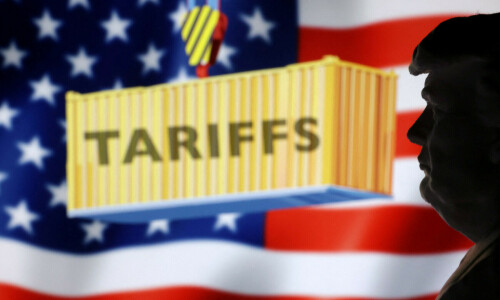

“The Federal Reserve (Fed) needs more time to see how the economy responds to US President Donald Trump’s tariffs and other policies before figuring out the right response,” President and Chief Executive Officer of the Federal Reserve Bank of Cleveland Beth Hammack said last week, noting that much of the administration’s sweeping agenda remains unclear.
“I stand ready to move whenever we have clear and convincing evidence, but given the overall breadth of the policies that have been discussed and put in place, I think there’s a real question about what those impacts are going to look like, and so it may take longer,” Ms Hammack said.
“There’s not a lot of data between now and June,” when the Fed next meets to set interest rates, she said in an interview on the sidelines of a monetary policy conference at Stanford University’s Hoover Institution in which she elaborated on the Fed’s current dilemma.
While the latest data showed the US economy contracted at a 0.3 per cent annualised rate last quarter, for example, most analysts feel that’s not a clear signal of the economic direction because of distortions driven by trade policy; to Ms Hammack, the economy has been resilient, and the jury is still out on its future course.
‘It’s important for us to sit back and make sure we’re thinking about all of the different policies, and look at things holistically’
“It is all premature to me — I think everything is very fluid, and I think we need to really wait and see how the data plays out,” she said. Likewise, she and her fellow policymakers have noted the strength of the job market, where the unemployment rate stands at a low 4.2pc, but also acknowledge the risks to the labour market as businesses begin thinking about the fallout from new tariff policies. If the impact of tariffs lifting prices proves to be limited and the economy weakens, “we’d want to really focus on the employment side of our mandate”, she said.
The Fed this week left short-term interest rates in the 4.25-4.50pc range, where they have been since December. While tariffs raise the risk of both higher inflation and higher unemployment, Chair of the US Federal Reserve Jerome Powell said it’s not yet clear by how much, or for how long, or in what order, and with trade negotiations underway and the full scope of levies unknown, it’s too early to know how the Fed should respond. Contacts in Ms Hammack’s district are laying contingency plans to shrink their workforce if demand weakens, she said.
But, for now, firms are hanging on to their workers after years of finding it hard to hire, Ms Hammack shared. “People don’t know which way it will settle out,” she said. On inflation, she explained that tariffs could prompt only one-time price increases. But some businesses say they plan to make a series of price adjustments over time as they learn what level of import taxes they face — a process that could itself last until well into the summer. The longer the issues play out, Fed officials worry, the more risk there is that inflation becomes persistent. That would require a tighter Federal Reserve policy.
All in all, uncertainty over government policies is “clouding the outlook and raising the risks of higher inflation, slower growth, and softening in the labour market”, Ms Hammack said in remarks prepared for delivery at a conference. “Given the economy’s starting point, with inflation still elevated and with both sides of our mandate expected to be under pressure, there is a strong case to hold monetary policy steady at its current modestly restrictive setting.”
Taking no action, she added, is the best choice as the Fed looks to balance the potentially competing dangers ahead. “It’s important for us to sit back and make sure we’re thinking about all of the different policies, because they do work in different directions. The spending policies, deregulation, and all of these tariffs could have different consequences. And so it’s important for us to look at it holistically,” she explained.
Published in Dawn, The Business and Finance Weekly, May 12th, 2025