0
0

KARACHI, May 6: Following the directives of the World Bank, the Sindh government is preparing the next budget within a medium-term fiscal framework that will stipulate next three to five years’ provincial tax and non-tax revenue, current revenue expenditure of major sectors and development outlay.
Indicating the 2006-07 development outlay at Rs28 to Rs30 billion that will entirely be self-funded, officials anticipate the next fiscal year budget size at about Rs165 to Rs170 billion, showing a revenue expenditure at Rs130 to Rs135 billion.
Sindh government officials are hopeful of taking the annual development outlay to over Rs40 billion by the 2010. “The federal government’s Medium Term Development Framework (MTDF) stipulates an eight per cent annual increase in the provincial development funding, but we are confident of increasing this outlay by 16 to 20 per cent every year,” a well-placed source in the government said.
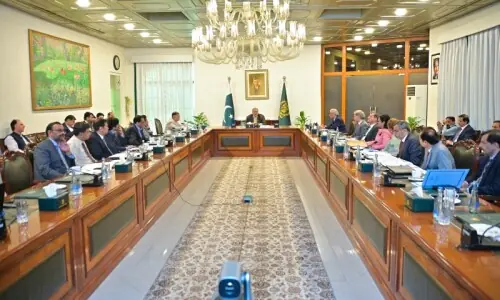
Broad outlines of the next development outlay will be discussed in the last week of this month when the Annual Plan Coordination Committee (APCC) meets early next month in the National Economic Council (NEC).
Top-level political leadership and senior bureaucrats of the federal and provincial governments participate in the NEC meeting that sets broad outlines of the next budget and sets in place certain benchmarks for the provinces.
The World Bank wants a budget document to reveal the impact of the government’s policy decisions in various sectors. For example, the bank wants the people of the province to know the impact of debt management on provincial finances. It wants the budget to inform the public of the impact of projects taken up by the provincial government.
There is a clear directive for the provincial government to give more detail of the allocations made for education and its impact.
By implication, the World Bank advice is to involve many sections of the civil society in budget making as well as in the budget review process that should go round the year. In practice, the Sindh government for the last few years and in this year too, did not involve chambers, trade associations, professional bodies, trade unions or any member of the civil society and even legislators of the opposition in the budget making. The opposition legislators on their own organised a pre-budget gathering a few weeks ago for which invitations were extended to the ministers and senior bureaucrats. No one turned up in the meeting, much to the dismay of the organisers that include lady provincial members of the PPPP, Shazia Marri and Dr Mehreen Bhutto.
For the last three years, the Sindh finance minister never held a mid-year budget review press briefing. There was hardly any debate or discussion on the growing unemployment, law and order, deteriorating health and education services, agricultural issues and water shortages in the province.
In its observations, the World Bank has appreciated about 13 per cent annual rise in the provincial tax revenue but has taken a notice of the poor collection of agricultural income tax, profession and calling tax and property tax.
The collection of agricultural income tax came down from Rs550 million in 2001-02 to Rs257 million in 2004-05, even though Sindh is home to many of the biggest feudal lords of the country who made big money from good wheat, cotton, sugarcane, value-added crops and fruit orchards.
The Board of Revenue remains a primitive and outdated government department where patwaris, tehsildars and mukhtarkars hold the fort and serve big feudal lords’ interests.
The cantonment boards are big factors in affecting the collection of property tax and calling and profession tax in Karachi.
The devolution of authority and funds and improvement in delivery of services at the lower level is another issue that is yet to be addressed. The district governments lack capacity to collect revenues, take up development projects and unable to deliver services at the desired level in education, health and other areas.
Big responsibility is on the political leadership of the district and tehsil governments. This leadership has come from the traditional feudal families that have no vision for development and public welfare.