0
0

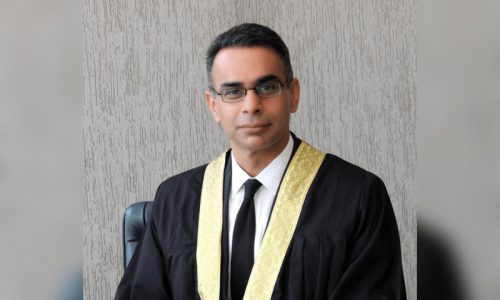
ISLAMABAD: In a dramatic courtroom episode, Justice Babar Sattar of the Islamabad High Court on Thursday openly challenged the authority of a division bench, rejecting its order suspending his previous directive to remove a citizen’s name from the Exit Control List (ECL).
The controversy erupted during contempt proceedings against senior officials, including the director general of Immigration and Passports and a National Accountability Bureau (NAB) director. The officials had allegedly failed to comply with Justice Sattar’s March 12 order to remove the name of the petitioner, Muhammad Sohail, from the no-fly list.
During the proceedings, the assistant attorney general, the deputy registrar, and the assistant registrar appeared before the court. The assistant attorney general presented a copy of the division bench’s interim order, stating that Justice Sattar’s directive had been suspended.
However, Justice Sattar responded that he would continue hearing the case and issue a comprehensive judgement, arguing that the division bench could not lawfully suspend a single bench’s order in such a manner.
Says he will continue hearing case, issue comprehensive verdict
“If a higher authority is needed, you go to the Supreme Court. A division bench is not a superior court; it is a forum of the same high court,” Justice Sattar said. “Only the Supreme Court has constitutional authority to issue such overriding orders.”
He criticised what he described as a historic first — a division bench stopping a high court judge from proceeding with a case via an interim order. “This has never happened before. This goes against the structure of judicial authority under Article 199 of the Constitution,” he added.
The hearing also revealed administrative irregularities. Justice Sattar grilled the court staff on why the cause list for his court was not issued, despite his explicit instructions.
Assistant Registrar Mohammad Irfan admitted to receiving an administrative order to redirect the case, while Deputy Registrar Sultan Ahmed cited procedural markings in the computer system. “Is the judiciary now governed by computers? IT systems are not the law,” Justice Sattar retorted sharply.
He also questioned whether the acting chief justice has the unilateral authority to reassign cases from one judge to another without a formal legal basis. “I have many cases pending — can the chief justice now transfer any of them arbitrarily?”
Justice Sattar stated that while he would not punish the court staff, the matter would proceed as per law.
The case at the centre of the controversy involves Muhammad Sohail, a citizen who filed a petition challenging actions taken by the Directorate General of Immigration and Passports.
Published in Dawn, May 9th, 2025