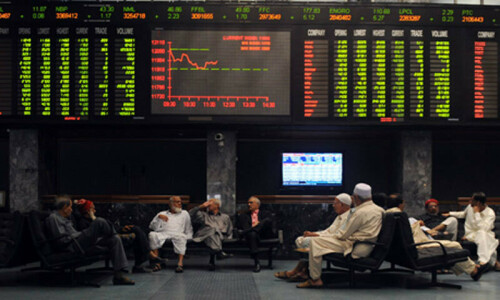
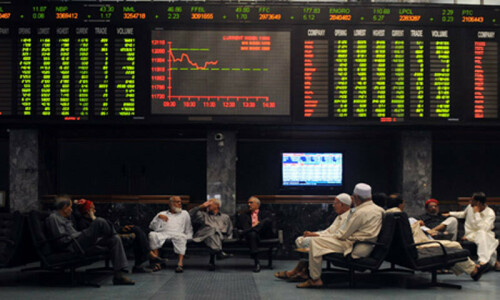
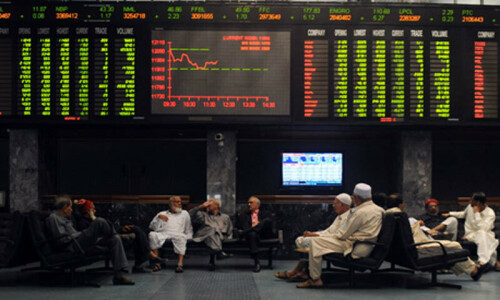
KARACHI: Rising tensions between nuclear-armed neighbours kept investors nervous, leading them to reduce their positions amid fears of full-scale war. This fuelled uncertainty about the economy and pushed the Pakistan Stock Exchange (PSX) further into the red zone in the outgoing week.
On Wednesday, the PSX witnessed a bloodbath caused by the information minister’s statement regarding an imminent attack by Indian forces within the next 24 to 36 hours. This news had scared investors who began offloading their holdings, wiping out a staggering Rs427bn from the market capitalisation as the benchmark KSE index suffered the third largest single-day loss of 3,546 points.
However, the last session of the week staged a strong rally as investors turned to value-hunting, helping the index to partially recover the losses it suffered on the eve of Labour Day.
In the preceding week, a host of negative news, including a downward growth revision by the International Monetary Fund (IMF) and a persistent decline in the foreign exchange reserves amid a weak rupee, halted a brief bullish momentum the market built on the back of some positive economic data.
AKD Securities Ltd said the market remained volatile throughout the week, primarily due to concerns over the potential escalation in tensions between Pakistan and India.
However, the market rebounded on the last trading day and recovered a significant portion of earlier losses as Pakistan allowed Afghan trucks to enter India via the Wagah border.
Moreover, positive signals from the US and Gulf countries urging de-escalation and a lower-than-expected inflation reading for April contributed to a recovery in sentiment in the weekend session.
As a result, the benchmark KSE-100 index closed the week with a loss of 1,355 points or 1.17pc to 114,114 week-on-week.
Corporate results also influenced stock-specific performance, particularly in the banking, cement, and technology sectors.
In April, inflation increased to 0.28pc year-on-year, compared to 0.69pc in March. In another positive development, Pakistan’s case for approval of the $1bn second tranche and $1.3bn Risilence Support Fund (RSF) programme from IMF’s executive board has been scheduled for review on May 9.
However, on the fiscal side, tax collection during the outgoing month fell short of the target, taking the 10MFY25 collection shortfall to Rs831bn. Additionally, trade deficit widened by 36pc to $3.4bn in April, due to a 14pc year-on-year increase in imports and 9pc decline in exports.
Market participation also weakened amid the prevailing volatility, with the average traded volume falling by 29pc to 424m shares compared to 599m shares in the previous week.
After opening at 117,874 in April, the benchmark index remained negative. It, however, hit an intra-month high of 120,797 but plumbed a low of 110,104 points. However, it closed the month at 111,327 points, marking a decline of 6,480 points or 5.5pc over March.
Trading was dominated by the March quarter result announcements, which were broadly lower than market expectations and weighed down on investor sentiment.
Week-on-week, investor participation declined as the average traded volume and value stood at 424m shares and Rs27.5bn, down 29pc and 6pc.
The sector-wise positive contribution was from vanaspati and allied industries, sugar and allied industries, and modarabas, up 30.2pc, 3.7pc 2pc week-on-week. On the other hand, transport, refinery, and pharmaceuticals reported a decline of 8.3pc, 6.5pc, and 5.9pc, respectively.
Flow-wise, barring debt, major net selling was recorded by individuals and foreigners with a net sell of $7.2m and $6.8m, respectively. On the other hand, mutual funds and other organisations absorbed most of the selling with a net buy of $5.4m and $5.1m, respectively.
With the anticipated policy rate cut in Monday’s upcoming State Bank of Pakistan’s Monetary Policy Committee meeting, the AKD Securities said the IMF Executive board’s approval of the second tranche and Resilience Support Fund programme would be key triggers as the likelihood of wider scale escalation between Pakistan and India remains low.
The brokerage house maintained an “overweight” stance on banks, E&P, fertiliser, cement, OMCs, autos, textile, and technology sectors, as they stand to benefit from monetary easing, structural reforms, reciprocal tariffs and a continued decline in commodity prices.
Published in Dawn, May 4th, 2025