0
0

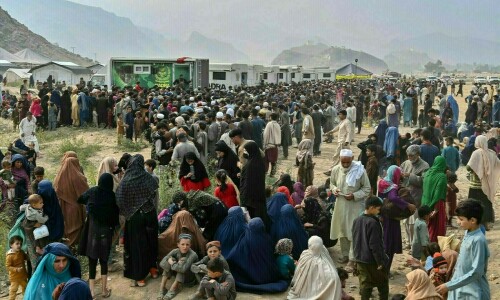
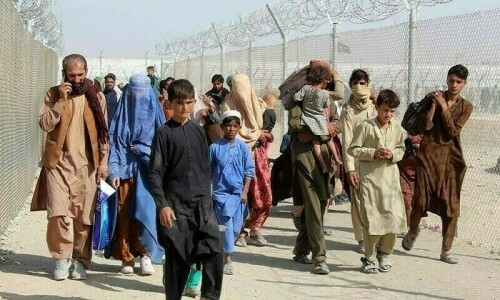
ISLAMABAD/WASHINGTON: The majority of Afghans who left Pakistan in April were living in the country illegally, according to data released by international agencies.
The number of Afghans who left last month was the highest since September 2023, said a report released by the UN refugee agency, UNHCR, on Thursday.
According to the report, 72 per cent of Afghans who left last month were undocumented, followed by 22pc with Afghan Citizenship Cards and 6pc with Proof of Registration cards.
The report ‘Core Pakistan-Afghanistan Returns Emergency Response’ said more than 144,500 Afghans returned to their country in April.
In April, around 24,400 Afghans were arrested by Pakistani authorities, representing over twice the 2024 rate.
Number of Afghans leaving Pakistan in April at 19-month high, say UNHCR, IOM; USCIRF says minorities at risk in Afghanistan
Most of the arrests and detentions took place in Punjab, followed by Balochistan.
Documentation trends
Separate data released by the International Organisation for Migration (IOM) also identified similar trends.
It said the number of undocumented individuals who left Pakistan between April 20 and 26 was higher compared to the previous week.
Around 65pc of Afghans, whom the IOM interviewed, said they had no documents.
The return of Afghans from Iran was also ongoing, IOM reported.
Around 14,909 male individuals entered Afghanistan using Abu Nasar Farahi and Milak border crossing points from Iran, accounting for 91pc of the total inflow, while female individuals were 1,487 or 9pc.
Need for support
UNHCR says Afghanistan has an estimated 3.22 million conflict-induced internally displaced persons (IDPs), 1.65 million IDP returnees and hosts around 20,900 refugees, requiring immediate protection and humanitarian assistance, as well as medium to long-term support.
In the first quarter of 2025, UNHCR has worked to scale up response capacities at border crossing points and encashment centers to provide protection assistance for the anticipated large-scale returns and deportations from Pakistan as part of the second phase of the Pakistan government’s Illegal Foreign Repatriation Plan (IFRP).
There are 2.8 million Afghans living in Pakistan, including refugees and those in refugee-like situations, with the implementation of IFRP Phase II likely to result in more than 1.4m Afghans (undocumented, refugees, and those in refugee-like situations) returning to Afghanistan.
Risk for minorities
The US Commission on International Religious Freedom (USCIRF), a bipartisan federal body that monitors and reports on religious freedom abroad, has expressed grave concern over the repatriation of Afghan refugees.
The agency warned the policy was putting vulnerable religious minorities at serious risk under the Afghan Taliban rule.
Since March 2025, Pakistan expelled an estimated 80,000 Afghans as part of its repatriation campaign that began in October 2023.
“The situation in Afghanistan remains dire for those who do not share the Taliban’s strict interpretation of Islam, including Christians, Shia Hazara, [Ahmadis] and Sikhs,” said USCIRF Chair Stephen Schneck.
“We are deeply concerned that religious minority communities will be in grave danger, especially women and girls, as Taliban officials seek retaliation against Afghans returned by the Pakistani government’s forced and accelerated repatriation efforts.”
USCIRF Vice Chair Meir Soloveichik warned the Taliban regime has created “terrible circumstances that put Afghan religious minorities at risk of severe persecution, including corporal punishment and arbitrary detention.”
Published in Dawn, May 2nd, 2025