Pakistan tells UN it has credible evidence of ‘regional adversaries’ sponsoring Jaffar Express attack



The Pakistan Mission to the United Nations on Tuesday said the country had “credible evidence” proving that the Jaffar Express attack was “externally sponsored by its regional adversaries”, according to a press release.
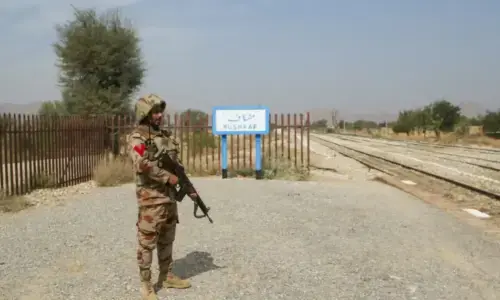
The Jaffar Express train was hijacked on March 11 when Balochistan Liberation Army (BLA) terrorists ambushed the Peshawar-bound train carrying 440 passengers, opening fire and taking hostages. Security forces launched a two-day operation, concluding on March 12. Inter-Services Public Relations Director General Lt Gen Ahmed Sharif Chaudhry said that all 33 terrorists were neutralised, but no hostages were harmed in the final rescue phase.
During the launch of the “Victims of Terrorism Association Network” by the UN Office of Counter-Terrorism at the UN headquarters in New York, Jawad Ajmal, a counsellor at the Pakistan Mission, expressed concern at the loss of tourist lives int he recent Pahalgam attack, and extended “heartfelt condolences to the near ones of the deceased and wish the injured a speedy recovery.”
According to the press release, Ajmal said that Pakistan possessed “credible evidence establishing that the attack on the Jaffar Express passenger train — in which at least 30 innocent Pakistani nationals were killed and dozens taken hostage — was externally sponsored by its regional adversaries.”
He noted that Pakistan joined fellow UN Security Council members in condemning the attack.
The counsellor further said that Pakistan had been one of the worst victims of terrorism for over two decades. With the loss of more than 80,000 lives and thousands more injured, Pakistan remains inspired by the resilience and strength of its nation.
“We pay tribute to the families of the martyrs from our law enforcement agencies and armed forces, who have made countless sacrifices to defend our motherland,” he added.
“The international community had a responsibility to support survivors of brutal terrorist attacks and the families of victims whose lives were permanently altered by such tragedies.”
He underscored the need for collective action to prevent future attacks, calling for holding terrorists and their handlers accountable and adopting a “uniform, victim-centric approach”.
“If we are to chart a way forward for victims, we must look beyond narrow political interests and geopolitical agendas. We must examine why, despite global strategies, terrorism threats continue to proliferate and give rise to an ever-increasing number of victims,” he stated.
“Pakistan unequivocally condemned terrorism in all its forms and manifestations, including right-wing extremism, Islamophobia, racially and ethnically motivated terrorism, and, above all, state-sponsored terrorism.”
Ajmal stressed that the world must address the root causes of terrorism and the conditions conducive to its spread. He also emphasised the importance of distinguishing terrorism from legitimate struggles for self-determination.
The counsellor highlighted the “need to address state-sponsored terrorism and underscored the necessity of reaching a consensual definition of terrorism that reflects emerging trends”.
“He added that challenges arising from the use of new tools — such as social media and the dark web — to deepen divisions and incite violence must also be combated,” the press release read.
He further called for efforts to counter disinformation campaigns designed to spread hate speech, xenophobia, and Islamophobia.
Ajmal also highlighted that the international community owes a moral and legal obligation to victims of terrorism to take effective, impartial steps to suppress terrorism wherever it exists and in whatever form.
“The more terrorism there is, the more victims there will be,” he noted.
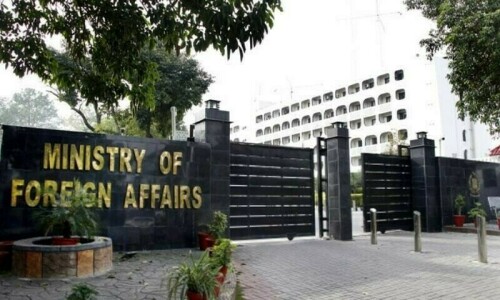
Last month, the Foreign Office said that the perpetrators of the attack on the Jaffar Express remained in touch with their handlers in Afghanistan throughout the incident.
During the briefing, FO spokesperson Shafqat Ali Khan was asked whether Pakistan had shifted its stance when it said that Afghanistan, and not India, was behind the terrorist attacks on Pakistan. He clarified that there was “no shift” in policy. “The facts have not changed. India is involved in sponsoring terrorism against Pakistan. What I was referring to was, in this particular incident, we have evidence of calls being traced to Afghanistan. This is what I said,” he said.
A day later, the DG ISPR called India the “main sponsor” of terrorism in Balochistan.
Lt Gen Chaudhry, who maintained that India was the main sponsor of terrorism in Balochistan, said the terrorists had used Afghan and foreign weapons in the recent incident and previous attacks. “We must understand that in this terrorist incident in Balochistan, and others before, the main sponsor is your eastern neighbour [India].”