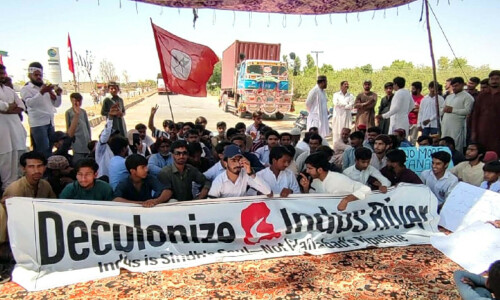
IT is official. Plans to build new canals on the Indus have been shelved till such time that all provinces can find themselves in agreement that they will serve the interests of the various claimants to the river’s waters.
The Council of Common Interests finally convened yesterday evening, following months of demonstrations and protests in Sindh over canals that were proposed to be built in the Cholistan region, to formally endorse the federal government’s policy, namely: “that no new canals will be built without mutual understanding from the CCI”. Thereafter, “It has been decided that the federal government will not move further until mutual understanding is evolved among the provinces”. The PPP will take the decision back to Sindh as a major triumph for the province’s people, many of whom had seen the proposed canal projects as a direct encroachment on their rights to a vital natural resource shared with another province, and had taken a strong position against the state’s plans.
According to the announcement, “the provisional Ecnec approval […] for construction of new canals and the Irsa water availability certificate […] [have been] returned. [The] Planning Division and Irsa are directed to ensure consultation with all stakeholders, in the interest of national cohesion and to address any and all concerns until mutual understanding is reached”.
This should be sufficient to address the suspicions that were being harboured by groups of protesters in Sindh, who had enforced a 10-day blockade of major logistical routes running through the province and had previously refused to disband despite the centre’s reassurances to the Sindh government that it would not proceed with the project. Now that the approval for the canals has been formally ‘returned’, the highways must be reopened and the thousands of goods transport vehicles that have been stranded for days allowed to proceed to their destinations. The economy has incurred major losses waiting for this breakthrough.
What is next? The press release issued after the CCI meeting suggested that the CCI would engage the provincial governments to chart out a long-term consensus on agricultural policy and management of the water infrastructure across the country. Furthermore, it has been announced that a committee is being formed to ensure food and ecological security with representation from the federation and the provinces. These are commendable steps, but perhaps should have been taken much earlier.
Nonetheless, it is encouraging that the provinces are being given a direct say in proposing solutions to challenges being faced at the provincial and national levels where agricultural policy and water utilisation are concerned. There is an urgent need for such high-level engagement and consultation, especially considering the climate-related crises Pakistan faces. Perhaps some good may have come out of this episode after all.
Published in Dawn, April 29th, 2025