• Saudi, Iranian FMs hold calls with their Pakistani, Indian counterparts, urge de-escalation
• UN chief voices ‘concerns’, asks nuclear-armed neighbours to show ‘restraint’
• FO warns New Delhi not to antagonise Islamabad after announcing Indus treaty suspension
• Troops exchange fire across LoC; Indian minister says plans ready to curtail water supply
ISLAMABAD: Saudi Arabia and Iran on Friday offered to mediate between Pakistan and India, urging restraint as tensions between the two nuclear-armed neighbours escalated following an attack in India-held Kashmir, earlier this week.
The April 22 attack in Pahalgam saw 26 people, mostly tourists, killed in what is being described as the deadliest armed attack in the disputed Himalayan region since the year 2000.
India has implied cross-border linkages of the attackers, while Pakistan strongly denied any involvement.
With both countries engaging in aggressive diplomatic, economic, and military posturing, the rapidly deteriorating relations have revived fears of a military confrontation similar to the 2019 Balakot crisis.
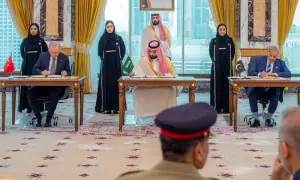
Amid growing international concern, Saudi Arabia and Iran, both of whom have good ties with the two countries, offered help to defuse tensions.
Saudi Foreign Minister Faisal bin Farhan held separate phone calls with his Pakistani and Indian counterparts.
A statement from the Foreign Office said Foreign Minister Ishaq Dar discussed regional developments with Mr Farhan, rejecting India’s accusations and cautioning against “further escalatory moves”.
The statement said Mr Dar reaffirmed Pakistan’s determination to respond firmly to any aggression and that both leaders agreed to continue consultations.

In a statement on X, Indian External Affairs Minister S. Jaishankar said he discussed the Pahalgam attack and its “cross-border linkages” with the Saudi foreign minister.

Meanwhile, Iranian Foreign Minister Abbas Araghchi also offered mediation via a post on X.
“India and Pakistan are brotherly neighbours of Iran, enjoying relations rooted in centuries-old cultural and civilisational ties,” he wrote. He added that Tehran was ready to “use its good offices in Islamabad and New Delhi to forge greater understanding at this difficult time”.
In a late-night statement after Aragchi’s call, the Foreign Office said, “DPM [Dar] … appreciated the efforts of Iran to diffuse the situation in the region.”
Earlier, in his weekly briefing on Friday, Foreign Office Spokesperson Shafqat Ali Khan had said that if any country offered mediation, Pakistan will consider it “at that point in time”.

UN concern
Meanwhile, United Nations Secretary-General Antonio Guterres also voiced “deep concerns” over the escalating tensions and urged both countries to exercise “maximum restraint”.
He called for the dispute to be resolved peacefully through “meaningful mutual engagement” and said the UN was closely monitoring the situation, though he has not directly communicated with either country’s leadership.
UN spokesman Stephane Dujarric told reporters in New York that issues between the countries “can be and should be resolved peacefully through meaningful mutual engagement”.
“We very much appeal to both the governments… to exercise maximum restraint, and to ensure that the situation and the developments we’ve seen do not deteriorate any further,” he said.
Warning to India
The Foreign Office also delivered a stark rebuke to India on Friday, warning it not to push Islamabad towards taking “extreme steps” after the Modi government notified the suspension of the Indus Waters Treaty.
“India should not create a situation where we are constrained to take extreme steps,” Foreign Office Spokesperson Shafqat Ali Khan said during the weekly briefing.
“Any attempt to dramatically alter or stop the water would be considered an act of war,” he warned.
“The Indus Waters Treaty is of critical importance for Pakistan’s water security and economy. Naturally, we will take all appropriate steps to preserve its sanctity and smooth implementation.”
Mr Khan criticised India for its “unlawful, unilateral, and irresponsible” suspension of the 1960 water-sharing pact.
Such actions “threaten the very foundations of the entire edifice of interstate cooperation and smooth implementation of the treaties”.
He stressed water continues to flow into Pakistan for now but said Islamabad will be closely monitoring the situation.
“We will see how it progresses, but all options are on the table for Pakistan. It is our lifeline. It is our right, sanctified by international law, customary law and bilateral treaties. We will do everything to secure this right for our people.”
The strong statements came as India doubled down on its decision to halt water flows into Pakistan.
In New Delhi, Water Resources Minister C.R. Paatil said the Indian government had prepared a detailed roadmap to block the water flow into Pakistan.
The announcement followed a high-level meeting chaired by Union Home Minister Amit Shah and attended by senior officials.
Mr Khan, the FO spokesperson, also addressed the retaliatory measures announced by the National Security Committee on Thursday.
He said threatening statements were made by New Delhi to create a “jingoistic and belligerent atmosphere”.
Firing at LOC
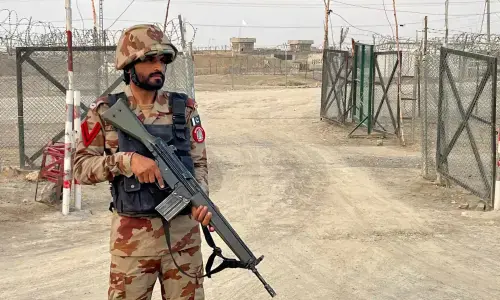
In another sign of acrimony between Pakistan and India, troops exchanged fire overnight across the Line of Control (LoC) in Kashmir, officials said on Friday.
Syed Ashfaq Gilani, a government official in Azad Kashmir, told AFP on Friday that troops exchanged fire along the line separating the two countries.
“There was no firing on the civilian population,” he added.
India’s army confirmed there had been limited firing of small arms that it said had been “initiated by Pakistan”, adding it had been “effectively responded to”.
Published in Dawn, April 26th, 2025