0
0

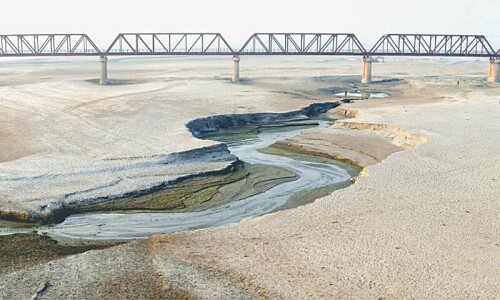
The Sindh government on Tuesday wrote to the Indus River System Authority (Irsa) over the “transfer” of water from the Indus River after the Taunsa-Panjnad Link Canal was opened.
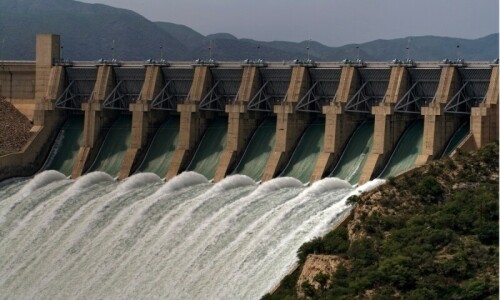
Last month, Irsa had called back-to-back meetings of its technical and advisory committee on March 25 and 26 for finalisation of water estimates and provincial shares for the coming Kharif season amid uncertainties over filling capacity of Tarbela Dam.
The Director Regulation Karachi wrote a letter to Irsa today, a copy of which is available with Dawn.com, requesting that the transfer of water from the Indus River to the Jhelum-Chenab system be stopped.
The letter also read that the release of water downstream to Panjnad “may be made in order to distribute the water amongst the provinces in an equitable and judicious manner”.
The director noted that as of today, the Taunsa-Panjnad Link Canal is being operated with a discharge of 2,981 cusecs.
The letter stated that during the first 10 days of April, the river inflows at Indus at Tarbela and Kabul at Nowshera were 21 and 23 per cent respectively — lesser than the minimum scenario adopted by Irsa for Kharif 2025.
“However, the inflow observed at Jhelum at Mangla has exceeded the minimum anticipated scenario by 20pc,” the letter added.
It continued that it was evident that water availability in Jhelum-Chenab system is much more than in Indus System during the first 10 days of April.
“Hence, releases downstream of Panjnad should be made in accordance with the observed river inflow pattern, rather than by initiating the operation of link canals, as doing so could rapidly reduce water availability for the lower riparian provinces,” the letter read.
It added that during the first 10 days of April, Sindh has experienced 62pc shortages with respect to Water Apportionment Accord and 55pc shortages with respect to Actual Average System uses (1977-82).
On the other hand, Punjab has experienced 54pc shortages with respect to Water Apportionment Accord and 52pc shortages with regard to Actual Average System uses (1977-82).
“To balance the water account, there is a need to release more water to Sindh province during the remaining period of April as IAC has decided the share for the month of April only,” the letter stated.
Canal controversy
On February 15, Punjab Chief Minister Maryam Nawaz and Chief of the Army Staff Gen Asim Munir inaugurated the ambitious Cholistan project to irrigate south Punjab’s lands amid public uproar and strong reservations in Sindh.
Meanwhile, the Sindh Assembly unanimously passed a resolution against the construction of six new canals on the Indus River in March, demanding an immediate halt to any plans, activities or work until an agreement was reached with all provincial governments.
The past few months have seen nationwide protests from political parties and civilians against the proposed canal project.
In February, the Awami Tehreek staged a 12-kilometre-long march in Karachi to protest against the project, while the PPP in March staged demonstrations and rallies across Sindh against the new canals.
Earlier in April, the Grand Democratic Alliance and PTI staged a sit-in outside the Karachi Press Club and led a rally to Empress Market against the proposed construction of the canals.
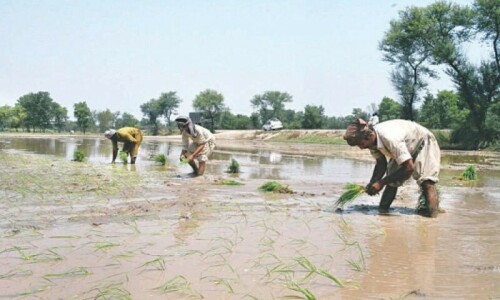
On Sunday, nationwide protests were held against corporate farming, the construction of six canals, lack of wheat support price, and privatisation of Pakistan Agricultural Storage and Services Corporation.
The protests were organised by the Pakistan Kissan Rabita Committee (PKRC) in 30 towns and cities, including Islamabad, Lahore, Bahawalpur, Rajanpur, Jhang, Kacha Khu (Khanewal), Bhakkar, Jatoi, Shikarpur, Larkana, Sukkur, Badin, Mardan, Dir, Malakand and Lakki Marwat.