Arid university stands the test of time


 0
0
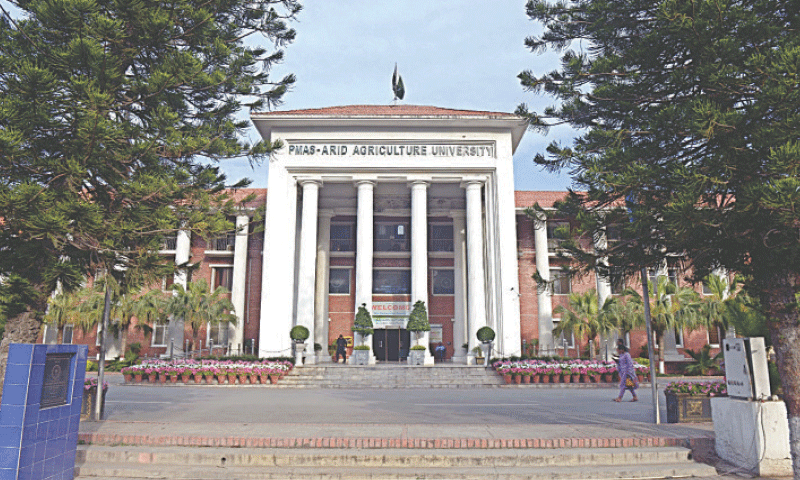

For the past three decades, Pir Mehr Ali Shah-Arid Agriculture University Rawalpindi has been steering ahead with a mission of enriching youngsters with quality education in agriculture sciences.
Starting as Barani Agriculture College run by the Punjab government in 1979, it imparted education to agricultural scientists who went on to gain prominence in the country at national and international levels.
The college was established on the recommendation of the Punjab Barani Commission in 1979, and it was upgraded to a university in 1994.
The primary objective of the university is to produce scientists and experts in the field of agriculture. It has also been exploring possibilities of creating a new agricultural landscape in the Potohar region through the exploitation of its topography, nutrient-rich soils and climate.
There are six faculties, six institutes, 11 directorates, and two centres: the Women Development Study Center (WDSC) and the Pak-Korea Capacity Building Center (PKCBC).
It has seven affiliated institutes in Punjab and has also established sub-campuses in Khushab and Attock. In addition, the university has a research farm on Mandra-Chakwal Road, as well as the Institute of Hydroponic Agriculture (IHA), and a veterinary hospital near Rawat.
“At present, a total of more than 12,500 students are studying agriculture and other subjects at the university. Apart from the main campus of the university, this process is also going on in the sub-campuses,” said Vice Chancellor Prof Dr Qamaruz Zaman.
l It started as a college in 1979, now the varsity has six faculties, six institutes, 11 directorates, and two centres
He said Arid Agriculture University has made constant efforts at staff development and nearly 80 per cent of the faculty members possess PhD degrees, while the others have MSc (Hons.) and MPhil degrees.
He said that the university offered a number of degree programmes leading to bachelor’s, master’s, M.Phil/MS and PhD degrees in different disciplines of agriculture, veterinary & animal sciences, forestry & range management, agricultural engineering, wildlife management & environmental sciences, business administration, computer sciences & information technology, biological sciences, social sciences and earth sciences.
About collaboration with other Pakistani varsities like Faisalabad, the vice chancellor said, “Yes, we believe in building up on each other’s strength to achieve common national goals. PMAS-Arid Agriculture University Rawalpindi is working cohesively and diligently to develop joint collaborations in various areas of education, research and technology incubation.”
He said that PMAS-Arid Agriculture University is also working with technical wings of various ministries both at the provincial and national levels to make the prime minister’s vision of agriculture and livestock development a reality.
He said that under the present scenario, international collaborations have become an integral part of a dynamic and emerging institution, adding that the university is in collaboration with a number of universities in the US, Canada, New Zealand, and China.
Besides the studies and research, he said that the varsity has also provided “significant facilities” to the students. It established a Director of Student Affairs, which acts as an advisor to students.
He said that the varsity has separate residential facilities (hostels) for boys and girls on the campus. Initially, this service was provided to about 40pc students. “University also maintains a health unit (medical centre) with a qualified doctor-in-charge and supporting paramedical staff. The service provides first aid and preliminary diagnostic facilities with appropriate medication. Plans are underway to expand this service in such a way that a test laboratory and X-ray facilities are provided,” he said.
“It maintained facilities for all major sports such as cricket, football, volleyball, basketball and track & field. The university teams participate in various national and inter-varsity games,” he said.
“Although the university campus is located at an accessible place right at main Murree Road, transport facility is available for pick and drop…and study tours for students,” he said.
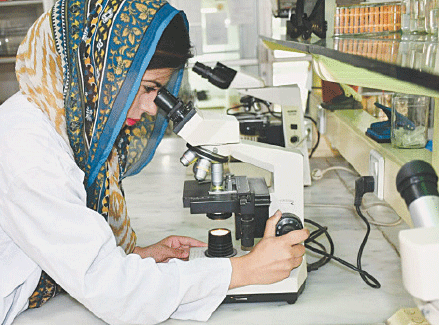
Talking about new initiatives of varsity, he said that it started the National Center of Industrial Biotechnology (NCIB), which will develop a national facility that can provide direct value addition to natural products isolated from plants and those derived from microbial origin.
“The pilot project for Data-Driven Smart Decision Platform (DDSDP) for increased agriculture productivity is framed to introduce smart technologies at selected farms. The Centre for Agriculture Strategy and Development (CAS-D) is developed to conserve the tradition but break the inertia so that the farming community can adopt contemporary agriculture tools and techniques. [Similarly] the National Center for Livestock Breeding Genetics & Genomics integrates science, practice, and innovation to serve the immediate needs of animal industries,” he said.
He said that the university took significant steps for digitisation. In this regard, a university management system (UMS) has been introduced, which is a smart, adaptable, and affordable IT-based solution that covers all aspects of the university.
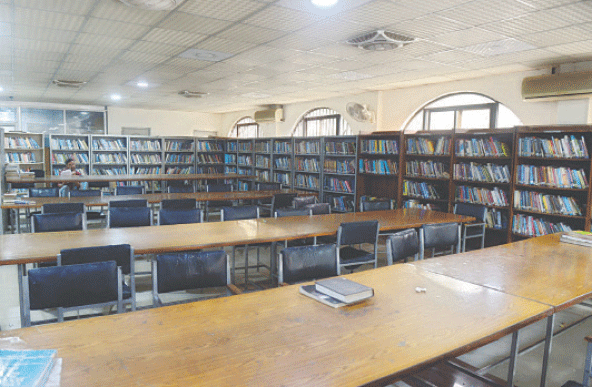
He said that the e-Library was equipped with the latest technology for access to e-Books, e-Thesis, online reference collections, Nobel laureate collections, e-Journals, documentaries, video lectures and other local and international resources.
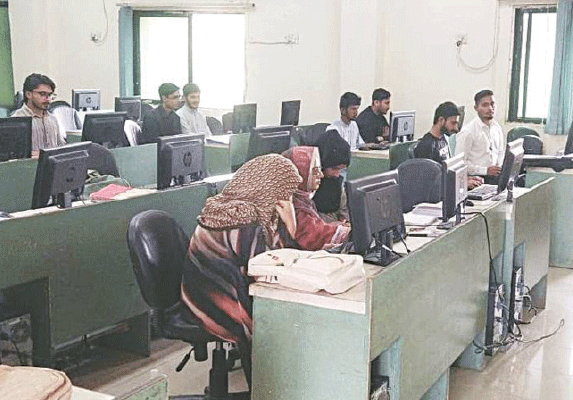
“Major objective of this digital library is revival of reading and learning culture among students, especially PhD scholars, and newcomers. A digital video recording studio is being established at the PRP department for preparing videos and documentaries regarding various activities taking place at the campus in the field of research, the university outreach programme for farming community, academic, curricular, co-curricular activities and other ongoing research projects funded by [the] HEC,” he said.
Published in Dawn, April 14th, 2025