0
0

• Study by Pakistan Institute of Development Economics says US policy should serve as ‘wake-up call’ for export diversification
• Warns tariffs may cost textile sector half a million jobs; leather, rice, surgical instruments, sporting goods also vulnerable
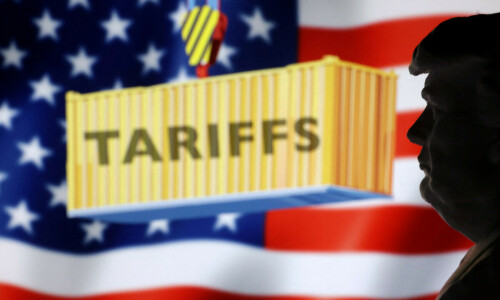
ISLAMABAD: The increase in trade tariffs on Pakistani products announced by US President Donald Trump — later suspended temporarily — could have a devastating impact on Pakistan’s important exports and serves as a wake-up call for diversification, according to a state-owned think tank.
“A storm may be brewing on Pakistan’s trade horizon,” said the Pakistan Institute of Development Economics (Pide), adding that the “proposed reciprocal tariffs by the United States could have a devastating impact on the country’s export sector”.
In a stark policy note, the institute cautioned that these tariffs could lead to macroeconomic instability, significant job losses and a critical reduction in foreign exchange earnings.
The study, titled ‘Impact of Unilateral Tariff Increase by United States on Pakistani Exports’ and conducted by Dr Muhammad Zeshan, Dr Shujaat Farooq and Dr Usman Qadir, analysed the consequences of a proposed 29 per cent reciprocal tariffs on Pakistani exports to the United States.
When added to the existing 8.6pc Most Favoured Nation (MFN) tariff, the total duty could reach 37.6pc, the policy note said. The result would likely be a 20-25pc decline in exports to the US, translating into an annual loss of $1.1-1.4 billion, with the textile sector bearing the brunt of the blow.
In the fiscal year 2024, Pakistan exported $5.3bn worth of goods to the United States, making it the country’s largest single-country export market. A significant portion of these exports were textiles and apparel, which already face tariffs as high as 17pc.
If the proposed tariffs are implemented, Pakistan’s price competitiveness would be severely eroded, possibly allowing regional competitors like India and Bangladesh to capture the market share.
The economic consequences would extend beyond textiles, the Pide analysis warned. Major exporters such as Nishat Mills and Interloop may be forced to reduce production, threatening more than 500,000 jobs. Non-textile exports — including leather, rice, surgical instruments and sports goods — also face increased vulnerability.
Despite the risks, Pide viewed the crisis as an opportunity for strategic transformation. The policy note encourages Pakistan to take swift and thoughtful action in response. In the short term, Pide recommended that Pakistan engage in high-level diplomatic efforts to highlight the mutual costs of the tariffs and preserve long-standing trade relations.
For example, the United States exported $181 million worth of cotton to Pakistan in 2024, a trade stream that is now at risk. Pakistan might also consider reducing tariffs on select US imports — such as machinery, scrap metal and petroleum — to create room for negotiation. Additionally, Pakistani firms could be encouraged to use more US-origin inputs like cotton and yarn to help maintain value chains and seek tariff exemptions.
For the long term, Pide emphasised the need to diversify both export products and markets. Emerging destinations such as the European Union, China, Asean nations, Africa and the Middle East offer growth potential in sectors like IT, halal food, processed foods and sports goods.
The report also called for measures to reduce energy and logistics costs, streamline regulations and promote innovation and technology adoption. Furthermore, a comprehensive US trade strategy is necessary — one that focuses on building synergies in technology, agriculture, energy and value-added manufacturing.
On the international front, Pide noted that the proposed US tariffs exceed the World Trade Organisation’s (WTO) bound tariff ceiling of 3.4pc, potentially violating multilateral trade rules. While legal recourse through the WTO remains an option, Pakistan’s limited fiscal resources may hinder such efforts, it said. More importantly, the tariffs ignore the interconnected nature of global trade.
The US-Pakistan textile loop is a prime example — American cotton supplies Pakistani mills, which in turn export finished garments to the US. Disrupting this value chain benefits neither country.
“The road ahead is challenging, but it also presents a chance for Pakistan to recalibrate and strengthen its export framework,” the report noted.
With timely diplomacy, strategic policy reforms and bold diversification efforts, Pakistan can not only withstand this external shock but also emerge as a more competitive and resilient player in the global economy, it concluded.
Published in Dawn, April 14th, 2025