US in hurry for nuclear deal, Iran says after high-stakes talks in Oman
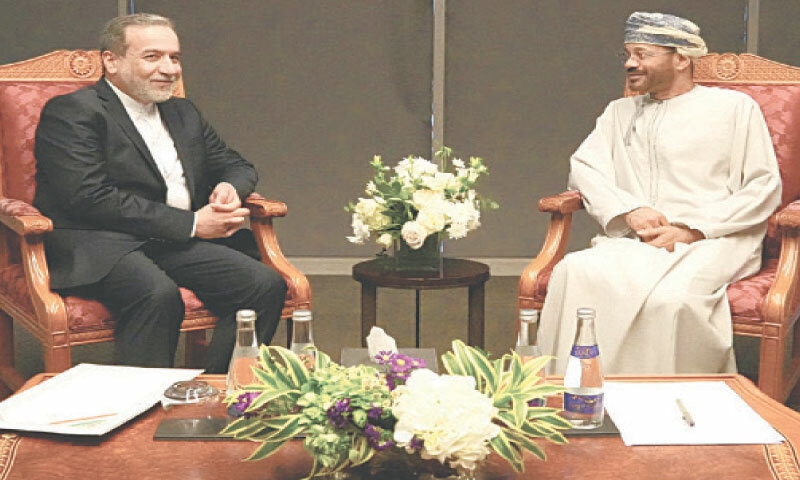

MUSCAT: The United States wants a nuclear agreement “as soon as possible”, Iran said after rare talks on Saturday, as US President Donald Trump threatens military action if they fail to reach a deal.
Foreign Minister Abbas Araghchi, who briefly spoke face-to-face with Trump’s special envoy Steve Witkoff during the indirect meeting in Oman, said the talks would resume next Saturday.
“The American side also said that a positive agreement was one that can be reached as soon as possible but that will not be easy and will require a willingness on both sides,” Araghchi told Iranian state television.
“At today’s meeting, I think we came very close to a basis for negotiation... Neither we nor the other party want fruitless negotiations, discussions for discussions’ sake, time wasting or talks that drag on forever,” he added.
Witkoff’s direct communication is a step forward in achieving a ‘mutually beneficial outcome’, White House says
A statement from the White House said: “The discussions were very positive and constructive. Special Envoy Witkoff’s direct communication today was a step forward in achieving a mutually beneficial outcome,” it said.
Oman’s foreign minister acted as intermediary in the talks in Muscat, Iran said. The Americans had called for the meetings to be face-to-face.
However, the negotiators also spoke directly for “a few minutes”, Iran’s foreign ministry said. It said the talks were held “in a constructive and mutually respectful atmosphere”.
The long-term adversaries, who have not had diplomatic relations for more than 40 years, are seeking a new nuclear deal after Trump pulled out of an earlier agreement during his first term in 2018.
Araghchi, a seasoned diplomat and key architect of the 2015 accord, and Witkoff, a real estate magnate, led the delegations in the highest-level Iran-US nuclear talks since the previous accord’s collapse.
The two parties were in “separate halls” and “conveying their views and positions to each other through the Omani foreign minister”, Iran’s foreign ministry spokesman Esmaeil Baqaei posted on X.
The process took place in a “friendly atmosphere”, Omani Foreign Minister Badr Albusaidi said.
Iran, weakened by Israel’s pummelling of its allies Hezbollah in Lebanon and Hamas in Gaza, is seeking relief from wide-ranging sanctions hobbling its economy.
Tehran has agreed to the meetings despite baulking at Trump’s “maximum pressure” campaign of ramping up sanctions and repeated military threats.
Meanwhile, the United States, hand-in-glove with Israel, wants to stop Tehran from ever getting close to developing a nuclear bomb.
Open to ‘compromise’
There were no visible signs of the high-level meeting at a luxury hotel in Muscat, the same venue where the 2015 agreement was struck when Barack Obama was US president.
Witkoff told The Wall Street Journal earlier that the US position starts with demanding that Iran completely dismantle its nuclear programme — a view held by hardliners around Trump that few expect Iran to accept.
“That doesn’t mean, by the way, that at the margin we’re not going to find other ways to find compromise between the two countries,” Witkoff told the newspaper.
“Where our red line will be, there can’t be weaponisation of your nuclear capability,” he added.
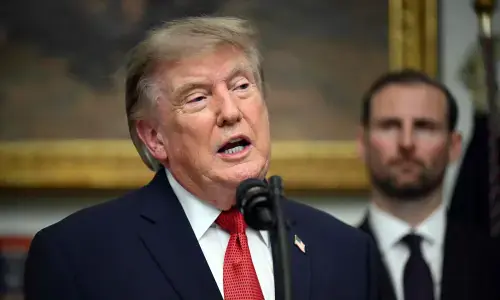
The talks were revealed in a surprise announcement by Trump during a White House appearance with Israeli Prime Minister Benjamin Netanyahu on Monday.
Hours before the talks began, Trump told reporters aboard Air Force One: “I want Iran to be a wonderful, great, happy country. But they can’t have a nuclear weapon.” Supreme leader Ayatollah Ali Khamenei’s adviser Ali Shamkhani said Iran sought “a real and fair agreement”.
The latest International Atomic Energy Agency report said Iran had an estimated 274.8 kilograms of uranium enriched to 60 per cent, nearing the weapons grade of 90 per cent.
Published in Dawn, April 13th, 2025