WIDE ANGLE: THE UNENLIGHTENED LOTUS


The new season of The White Lotus is set on a luxury resort on the Thai island of Koh Samui. This comedy-drama series, which critiques wealthy tourists, focuses one plotline on foreigners who arrive in Thailand with an interest in engaging with its Buddhist traditions.
It depicts a young American woman who is interested in joining a yearlong meditation programme at a Buddhist temple, even though Thai temples do not offer such programmes. It also portrays a temple environment with many foreigners staying there long term, not dressed in typical clothing for residents of a temple — unusual in Thailand — and inaccurately describes the Buddhist view of the afterlife.
I have studied Buddhism in Thailand for over a decade, including the diverse ways in which Thai Buddhists practise their religion. While the Thai Buddhism depicted in The White Lotus is not completely realistic, there are several authentic ways to engage deeply with Buddhism, ranging from offering donations to short meditation retreats to ordination as a monastic.
Generosity and Buddhist laity
Without donations, Buddhist temples and monastic institutions could not exist. The lay community provides for monks and temples, in exchange for the spiritual currency of merit, which is believed to turn into good karma.
What The White Lotus gets wrong about the meaning and goals of common Buddhist practices
This good karma is believed to produce favourable conditions in this life and the next life, such as attaining wealth or being reborn into a privileged family.
Some laypeople might give food to monks as they walk on their alms rounds every morning, while others may visit the temple only on most Buddhist holidays. The main intention behind interacting with a monk or visiting a temple is to make merit.
Each temple has donation boxes for specific funds it needs, such as paying the electricity bill, completing renovation projects, providing education for young monks and funding the monastic community’s healthcare.
People can take home blessed objects such as a lucky candle or small amulet in exchange for a small donation. In some temples, a monk’s duty is to sit inside one of the main halls and wait until the laity comes to receive offerings and give blessings.
Meditation retreats
Temples with meditation centres generally offer meditation retreats for a short period of time. Many offer 10-day retreats; participants can also sign up for a 21-day programme in the north of Thailand, where they will aim to spend their days in 10-15 hours of meditation and minimise any other activity, including sleep.
Participants in the 21-day programme aim to reach the first of the four stages of enlightenment within Thai Theravada Buddhism. Buddhists believe that those who attain the first stage have “entered the stream” of enlightenment and are guaranteed to attain it within seven lifetimes.
Contrary to popular Western beliefs about Buddhist meditation, it is not viewed as a secular practice. Thai Buddhists believe that meditation is a meritorious activity, helping them not only to ultimately leave the cycle of rebirth but also to accumulate merit and good karma along the way — in this life and future ones.
At a meditation centre, every moment is spent in mindfulness of every action, along with periods of formal walking or sitting meditation. All meditation centers have a structured programme and schedule that practitioners, typically dressed in white pants and top, must follow individually or in group periods of meditation.
Ordination of men and women
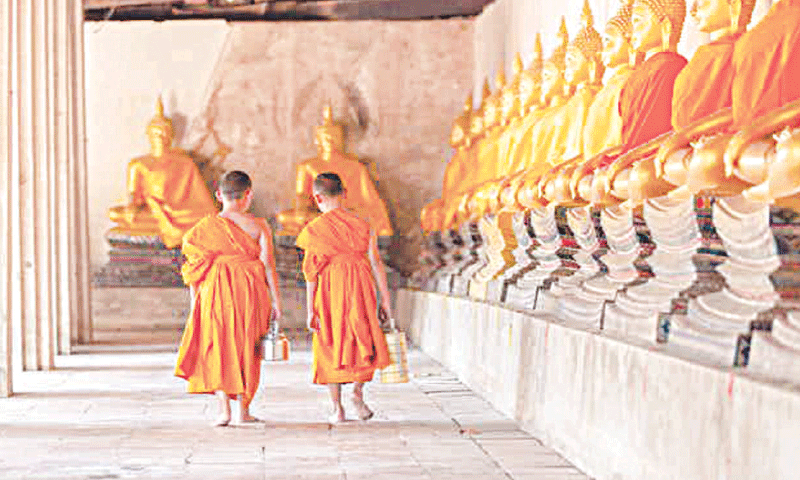
Ordination is an important part of the Buddhist life course. Thai Buddhists often enter a monastery for a short period of time, temporarily being ordained as a monk or nun.
Even for those who intended to enter for life but choose to leave the monastic life, the process is simple; it usually carries no shame or disappointment. However, if a monk was well known for his teaching, his followers would likely feel upset.
In Theravada Buddhism, the kind of Buddhism practised in Thailand, there are two levels of ordination: novice and full “bhikkhu” — the term for a fully ordained male. Males under the age of 20 may pursue only novice ordination, while those over 20 can become fully ordained monks.
It is often considered a rite of passage, or at least a sign of discipline and maturity, for a male to have been ordained at some point in his life. Temporary ordination is seen as a way for men to make merit for their parents, especially their mothers, who sacrificed so much for their existence.
Women are generally not allowed to be ordained in Thai Buddhism, but some have received ordination in Sri Lanka, where they are allowed to be monks, and set up communities in Thailand, which are gaining in popularity. These female monastic practice centres have initiated temporary ordination programmes for female monks, or “bhikkhuni.”
These centres host special programmes once or twice a year, where up to 100 women, including international visitors, can ordain as novice female monks for a short period. During this time, they learn what it is like to wear the robes, receive offerings and study the Buddhist texts.
Many women find this opportunity meaningful because they can offer merit to their parents, which was previously only available to a male.
Women can also ordain temporarily or long term as a “mae chi” in Thailand, or a precept nun. They usually follow Eight Precepts, including celibacy, wearing white robes and shaving their head. Although more accepted today in Thailand as a role for Buddhist women than bhikkhuni, this category of ordination was not initiated by the Buddha. Precept nuns are believed to have existed for centuries, but without a clear origin.
These are some common ways in which Thai Buddhists practise Buddhism, often with the goal of achieving prosperity in this life and a better rebirth. Such practices, Buddhists believe, may also get them closer to the ultimate aspiration of enlightenment.
The writer is an Associate Professor of Religious Studies at Rhodes College in the UK
Republished from The Conversation
Published in Dawn, ICON, April 13th, 2025