US stocks down as trade war with China escalates; EU pauses countermeasures


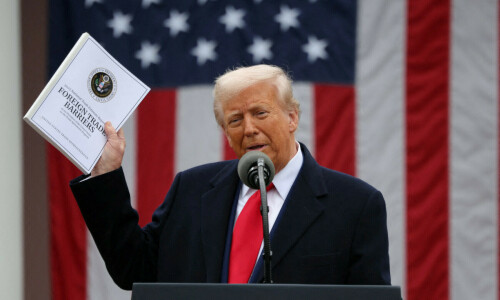
American stocks sank on Thursday, giving back some of the huge gains that followed United States President Donald Trump’s decision the day before to temporarily lower his sweeping tariffs on dozens of countries, as investors assessed the status of his global trade war.
The S&P 500 index was down 5.2 per cent on Thursday afternoon, while the Nasdaq dropped 6.1pc and the Dow Jones Industrial Average was down 4.5pc.
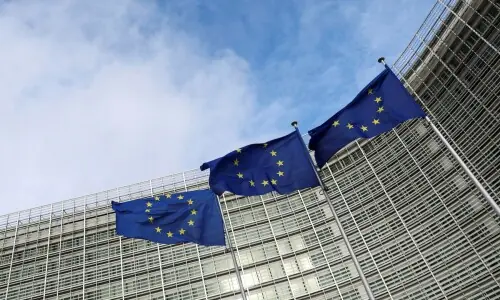
The European Union (EU) said it would pause its first counter-tariffs, and more than a dozen countries have made offers to the United States, according to White House economic adviser Kevin Hassett.
Trump’s sudden decision on Wednesday to freeze most of his hefty new duties for 90 days brought relief to battered markets and anxious global leaders, even as he ratcheted up a trade war with China. The White House said that tariffs on China are now effectively 145pc after counting levies that Trump charged soon after becoming president.
But Trump’s whipsaw approach has companies still worried about the potential fallout and scrambling to prepare for what could happen in three months.
His turnabout, less than 24 hours after the tariffs kicked in, followed the most intense episode of financial market volatility since the early days of the Covid-19 pandemic.
The EU had been due to launch counter-tariffs on about €21 billion ($23.25bn) of US imports next Tuesday in response to Trump’s 25pc tariffs on steel and aluminium. It is still assessing how to respond to US car tariffs and the broader 10pc levies that remain in place.
“We want to give negotiations a chance,” European Commission President Ursula von der Leyen said on X. But she warned that the counter-tariffs could be reinstated if negotiations “are not satisfactory”.

The Trump administration is close to reaching agreements with some countries, Hassett told reporters at the White House on Thursday.
“USTR has informed us that there are maybe 15 countries now that have made explicit offers that we’re studying and considering and deciding whether they’re good enough to present the president,” Hassett added, referring to the US trade representative.
Principals in the administration’s trade policy will meet at the White House on Thursday to discuss how to prioritise the separate negotiations, Hassett said. Thursday’s stock drop came despite US data showing consumer prices fell unexpectedly in March. However, the improvement in inflation is unlikely to persist if high tariffs on Chinese goods remain in place.
Trump kept the pressure on China, the world’s No. 2 economy and second-biggest provider of US imports, by increasing tariffs on Chinese imports to 125pc from the 104pc level that kicked in on Wednesday.
The White House told CNBC on Thursday that that brings the overall rate of new tariffs imposed by Trump on China to effectively 145pc when taking into account the 20pc tariffs that Trump imposed on China earlier this year over fentanyl concerns.
Moreover, everything he has imposed since returning to the White House this year is also stacked on top of other tariffs that Trump implemented during his first term in office.
US stock indexes shot higher on Trump’s Wednesday announcement, and the relief continued into Asian and European trading on Thursday.
Before Trump’s U-turn, the upheaval had erased trillions of dollars from stock markets, raised fears of recession and led to an unsettling surge in US government bond yields that appeared to catch Trump’s attention.
Clay Lowery, a former senior Treasury official and executive vice president of the Institute of International Finance, said Trump’s reversal reflected concern that investors were taking assets out of both the stock market and treasuries.
“The 10-year treasury yield was going up, and it was going precipitously,” he said. “That was the catalytic event. Having volatility in the markets, okay, but we’re not trying to create a financial crisis or financial stability problem here.”
Trade war with China
China rejected what it called threats and blackmail from Washington. “China will follow through to the end if the US persists,” Commerce Ministry spokesperson He Yongqian told a regular press briefing.
China’s door was open to dialogue, but this must be based on mutual respect, the ministry said. Beijing may again respond in kind after already imposing 84pc tariffs on US imports on Wednesday to match Trump’s earlier salvo.
Trump, who claims the tariffs aim to fix US trade imbalances, said a resolution with China is also possible. But officials have said they will prioritise talks with other countries as Vietnam, Japan, South Korea and others line up to try to strike a bargain.
China’s yuan hit its lowest level against the dollar on Thursday since the global financial crisis. In Europe, eurozone government bond yields jumped, spreads tightened and markets scaled back their bets on European Central Bank rate cuts after Trump’s latest announcement. European shares surged.
The US tariff pause does not apply to duties paid by Canada and Mexico, because their goods are still subject to 25pc fentanyl-related tariffs unless they comply with the US-Mexico-Canada trade agreement’s rules of origin.
Uncertainty and concerns
Oil prices retreated by more than 3pc on Thursday as fears of a deepening US-China trade war and a possible recession eclipsed earlier relief created by Trump’s pause announcement.
Some central bankers also remained cautious. European Central Bank policymaker Francois Villeroy de Galhau told France Inter radio it was “less bad news” than before, but that ongoing uncertainty remained a threat to trust and growth.
And business leaders warned that not all was resolved. The head of the French wine and spirits lobby group FEVS said Trump’s decision to hit pause was “half good news”.
Nicolas Ozanam said the move will initially allow companies to resume shipments with lower tariffs, and therefore at the same level as other suppliers.
However, the 90-day window created logistical constraints, and given that 10pc customs duties remained in place, the sector still faced inflationary pressures. “This will still lead to a rise in prices and therefore a drop in consumption in the United States,” he told Reuters.