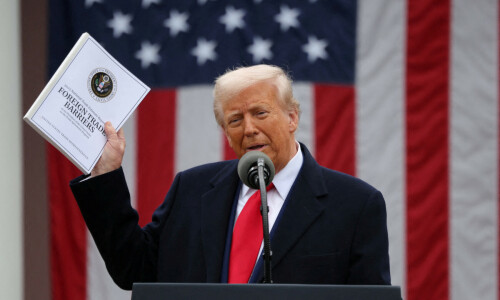
WASHINGTON: More than 50 countries have reached out to the White House to begin trade talks, a top economic adviser to US President Donald Trump said on Sunday as US officials sought to defend sweeping new tariffs that have unleashed global turmoil.
During an interview on ABC News’ ‘This Week,’ US National Economic Council Director Kevin Hassett denied that the tariffs were part of a strategy by Trump to crash financial markets to pressure the US Federal Reserve to cut interest rates.
He said there were would be no “political coercion” of the central bank.
In a Truth Social post on Friday, Trump shared a video that suggested his tariffs aimed to hammer the stock market on purpose in a bid to force lower interest rates.
EU expected to approve targeted countermeasures on US imports
However, US Treasury Secretary Scott Bessent in a separate interview on NBC News’s Meet the Press, downplayed the stock market drop and said there was “no reason” to anticipate a recession based on the tariffs.
Trump jolted economies across the world after he announced broad tariffs on US imports on Wednesday, sparking fears of a globe trade war and recession as the EU may join Canada and China in imposing retaliatory tariffs on the US in an early escalation of what some fear will become a global trade war.
On Sunday morning talk shows, top Trump officials sought to portray the tariffs as a savvy repositioning of the US in the global trade order and the economic disruptions as a short-term fallout.
US stocks have tumbled by around 10pc in the two days since Trump announced a new global tariff regime.
Tariff-stunned markets face another week of potential tariff turmoil, with fallout from Trump’s sweeping import levies keeping investors on edge after the worst week for US stocks since the onset of the Covid-19 crisis some five years ago.
Hassett told ABC News’ ‘This Week’ that Trump’s tariffs had so far driven “more than 50” countries to contact the White House to begin trade talks. Unlike other economists, he said he did not expect a big hit to consumers because exporters were likely to lower prices.
Also, Bessent downplayed chances for a recession based on the tariffs, citing stronger-than-anticipated US jobs growth. “We could see from the jobs number on Friday, that was well above expectations, that we are moving forward, so I see no reason that we have to price in a recession,” he reasoned.
On the other hand, European Union countries seek to present a united front in the coming days in first strike back at Trump tariffs as the 27-nation bloc is set to face new 20pc US tariff from next week.
The EU members are expected to approve a first set of targeted countermeasures on up to $28 billion of US imports from dental floss to diamonds.
Such a move would mean the EU joining China and Canada in imposing retaliatory tariffs on the United States in an early escalation of what some fear will become a global trade war.
The 27-nation bloc faces 25pc import tariffs on steel and aluminium and cars and “reciprocal” tariffs of 20pc from Wednesday for almost all other goods.
Trump’s tariffs cover some 70pc of the EU’s exports to the US — worth in total $585 billion last year — with likely duties on copper, pharmaceuticals, semiconductors and timber still to come.
The European Commission will propose to members a list of US products to hit with extra duties in response to Trump’s steel and aluminium tariffs rather than the broader reciprocal levies.
However, among EU members, there is a spectrum of opinions on how to respond. France has said the EU should work on a package going well beyond tariffs and President Emmanuel Macron has suggested European companies should suspend investments in the US until “things are clarified”. Ireland has called for a “considered and measured” response, while Italy has questioned whether the EU should hit back at all.
Published in Dawn, April 7th, 2025