THE UN’s recently released World Water Development Report 2025 has amplified concerns about the water future of the Indus Basin. The report paints a grim picture of retreating glaciers that have imperilled the future of billions dependent on glacial melting. It reveals that glacier retreat in the Hindukush-Himalayan (HKH) region is alarming — 65 per cent faster during 2011-2020 compared to the previous decade. They are also melting faster than the global average.
The HKH region, spread over 3,500 kilometres, is often referred to as the water tank of 10 large Asian river systems, including the Indus. The basins of these rivers provide water to 1.9 billion people — nearly a quarter of the world’s population. In the long term, diminished water flows are likely to trigger droughts that may endanger food, water, energy and livelihood security in the region.
Recently, the Met Office issued a fresh drought warning in the country. A protracted drought has manifested its severity in empty reservoirs and dwindling flows at barrages. The advisory warns that the conditions persist in Sindh, southern parts of Balochistan, and the lower eastern plains of Punjab. Overall, the country has received 40pc less rainfall. Sindh is the worst-hit, with 62pc below-normal showers recorded since September 2024. In an ominous forecast, the advisory states that the emergence of flash droughts is also anticipated in the coming months in light of the lasting rainfall deficit and increasing temperatures.
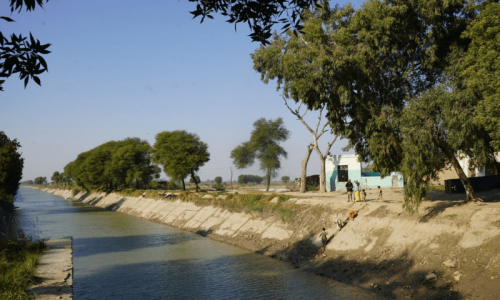
The Tarbela and Chashma reservoirs have touched dead-level, and the Indus carries scant flows. On World Water Day last month, Sindh was struggling to manage a 51pc shortage in water flows. Some canals were receiving 70pc less than the required discharges. Irrigation officials were imploring farmers to desist from sowing, as barely any drinking water was being released into watercourses. Kharif starts early in Sindh, and water requirements reach 40,000 cusecs by early April, whereas the province is receiving less than 20,000 cusecs. The weather prognosis is adding to the consternation, with a flash drought already forewarned. Temperatures in Sindh rise steeply in April, which can evaporate residual soil moisture, leaving crop fields parched. The production of Kharif crops — cotton, sugarcane, mangoes, bananas, and vegetables — will be negatively affected in Sindh if flows do not improve by mid-April.
A drought emergency should be declared.
The Indus River System Authority has declared 43pc shortfall in water during April. The emerging situation is alarming, as the frequency of drought at the early Kharif stage has increased in recent years. In five of the last 10 years, the Tarbela Dam reached dead-level by the third week of March. Meanwhile, Mangla Dam shows relatively better storage during this period. However, at such a critical stage, Sindh seldom receives any supplies from Mangla, as Punjab prefers to store water for its own Kharif needs. Sindh has been resenting this practice.
Water availability in the Indus Basin has declined over the first quarter of this century. Flows in both the eastern and western rivers have dropped due to natural and human activity. Discharge data at rim stations indicates that average inflows at the rim stations of western rivers (Indus, Jhelum, and Chenab) stood at 135.82 million acre feet during the 1976-1998 period but declined significantly to 120.79 MAF during 1999-2023. Similarly, the eastern rivers (Ravi, Sutlej, and Beas) have seen a dip from 9.35 MAF to 2.96 MAF during the same period.
It is against this backdrop that new canals and corporate farming are being strongly denounced in Sindh. The province is rattled by relentless protests, vehemently decrying the construction of new canals and the corporate farming scheme in the Cholistan area.
The Indus Basin has not received any major riverine flood since 2010. The last devastating flood in 2022 was caused by abnormal rains and torrential flows from mountain ranges bordering Sindh and Balochistan. An overall declining trend in flows has become more pronounced in recent years. While the vagaries of climate can also trigger massive floods, droughts appear to be the dominant climatic feature in the coming decades. As average temperatures rise and precipitation becomes scanter, the long-term scenario turns murkier.
Both near- and long-term scenarios are unfavourable for developing new command areas or undertaking large-scale farming schemes — particularly those involving international commodity trade. Priorities must shift from engineering-centric infrastructure to conservation and improved water management. A national drought emergency should be declared to formulate a long-term drought mitigation plan and policies focused on enhancing land and water productivity.
The writer is a civil society professional.
Published in Dawn, April 6th, 2025