Karachi’s Safari Park elephants in ‘good condition’; experts prepare for TB test


 0
0


• Four Paws team to collect samples from Malika and Madhubala later this month
• Dr Khalil says all keepers tested negative for tuberculosis
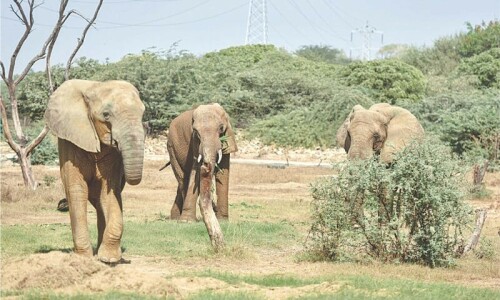
KARACHI: While final lab tests for confirmation of an active TB infection in two Safari Park elephants are yet to be performed, their all keepers have tested negative for the highly contagious disease, experts said.
They said both Malika and Madhubala, the two Safari Park elephants, are well and currently show no signs of tuberculosis.
Sources said the elephants, along with their keepers, have recently completed their three-day training on medical assessment and treatment, which was conducted by Four Paws’ trainer Mathias Otto.
The training followed extensive medical assessments carried out early last month after the death of their sister Sonia, whose post-mortem report indicated that she was infected with TB along with other ailments affecting all her vital organs.
The source said the preliminary findings of the genetic tests conducted last month showed low protein levels and traces of TB infection in both elephants.
Dr Amir Khalil, the head of Four Paws’ team which has been assisting the Karachi Metropolitan Corporation (KMC) in all aspects of elephant care from blood sample collection to surgical treatment for the past several years, told Dawn that while genetic tests were very precise for humans, this was not so in case of elephants.
He said: “The genetic test only indicated that both Malika and Madhubala are just a carrier of the [TB] bacteria, a condition that we describe as a latent infection. It indicates that the animal might have the infection in the past or had been exposed to TB infected animals at some point.
“No treatment is required for a latent TB infection as elephants can stay lifelong carriers [of the bacteria]. But, this condition can turn into an active infection, if their immune system weakens that would then require immediate treatment as they can spread the disease [to humans and animals],” he said.
According to Dr Khalil, a culture test is the only way to be 100 per cent sure about the elephants’ infection status without which the treatment can’t start.
“Having said that, the elephants right now are being looked after as ‘infected’ and the same is shown in their official records. We have made recommendations for maximum caution given the severity of the disease that they might have,” he said, adding: “We are keeping our fingers crossed and the good news is that all the keepers have tested negative for TB.”
‘Challenging treatment’
TB in elephants, Dr Khalil points out, is treatable but the treatment is costly, can take one to over two years and the medicines have sure side-effects including loss of weight.
“This is why it’s important to be sure that they have an active TB infection before starting the treatment. It involves intra-rectal administration of drugs for which the animals and the staff both required training,” he said.
Safari Park Director Amjad Zaidi shared that the KMC was ensuring the best treatment to elephants, both of which were in good condition. “The mayor is taking personal interest in their care. It’s good that the disease is detected in its initial stages.”
The sources said samples for TB’s confirmation were drawn last month in trunk wash testing — a diagnostic procedure for elephants designed specifically for culturing TB germs. But, they couldn’t give complete results due to low bacterial count.
The FP team comprising Dr Khalil, Dr Marina Ivanova and Dr Frank Goritz is expected to arrive later this month to collect the samples again.
It might be recalled that the city has lost two of the four captive elephants in less than two years.
The KMC has recently set up an 18-member body to look after their well-being.
Published in Dawn, March 17th, 2025