Can Nato remain relevant?
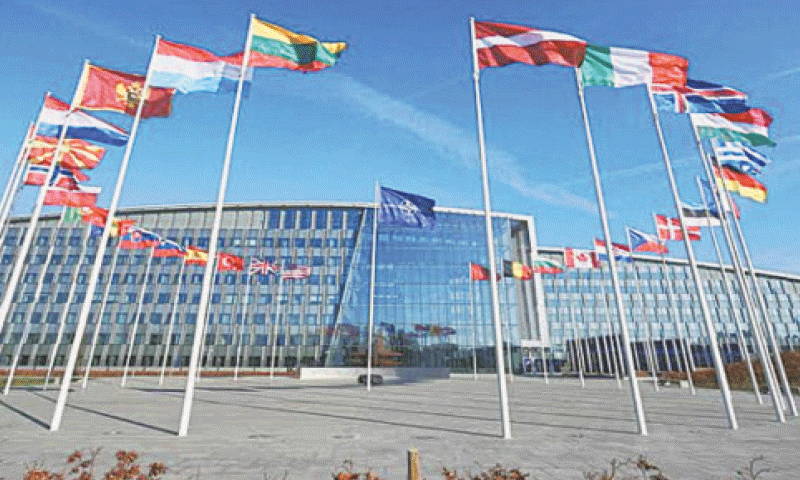


THE ongoing dilemma surrounding Nato’s expanding portfolio of tasks has intensified under the Trump 2.0 administration which increasingly exposes an inner tension regarding the financial burdens associated with the alliance.
This shift suggests a hardline nationalist cost-benefit analysis that risks undermining the foundational commitment essential for maintaining the post-Cold War security architecture in Europe.
Such an approach not only jeopardises European security but also challenges the legitimacy of nation-states within Europe, whose stability is closely tied to Nato’s responsibility in deterring Russia’s sturdy posturing. Any wavering in understanding European security could erode regional safety, although pulls of globalisation increasingly operate to replace geography. This indicates that Nato being hitherto pivotal to Europe’s evolution and transition from a traditional economic union to a more resilient coherence can no longer be taken for granted as a trusted security provider.
Let us analyse the possible scenarios of Nato’s dithering: First, Nato plays a crucial role in cementing the bond that holds the political union of the European countries together. In the event of Nato’s retreat or fissures in solidarity, European democracies might find them in chaotic divisive conditions and fall into rival groups. This division could lead to increased tensions, recriminations and squabbles among European powers, potentially destabilising the region.
Second, the tussle between European powers and America, stylistically being termed as ‘Atlantic decoupling’ could set in motion mutual resentment and a frenetic style of recriminations. However, this should not be overextended to mean that Europe is opposed to Nato. It has been well argued in a piece published in The Statesman that for Britain it is not a cakewalk but a matter of delicate balancing to match “British interests while navigating Mr Trump’s transactional approach to international relations”.
Likewise, from France to Germany to Italy, everyone recognises that without Nato things would go from bad to worse, hence, any betting on having or not having Nato is to invite risk deliberately. Yet, the primary concern is undoubtedly Trump’s obsessive MAGA and associated megalomania that not only dampens US-Europe camaraderie but undercuts the manoeuvring space in diplomatic parleys too.
So, if Europe slips from Nato’s priority list or more precisely as Spykeman’s concept of Europe’s maritime rimland suggests, any shift of Nato’s focus from Europe’s geographical rim takes place, it is likely to embolden rival powers, strain transatlantic relations, and divide European democracies, ultimately leading to accentuated instability and insecurity.
European countries are also aware of their relatively smaller military capabilities and of the absence of an assumed perennial utopian state of peace, often referred to as Elysium. Despite the ongoing debates that may divide them on various issues, there is by and large a consensus from Berlin to Warsaw regarding the significance of Nato and Washington that complement as foundational elements of Pax Americana. This framework not only serves as a pressure valve for geopolitical tensions in Western Europe but also acts as a crucial security provider against threats posed by illiberal states.
For instance, while Germany may consider choosing Russia for gas or engage with China for telecommunications, dependence on initiatives like the One Belt One Road (OBOR) might at some point inadvertently expose Europe to the Western narrative associated with Russia’s assertive stance or Chinese dominance over critical security technologies. Thus, the balance between economic engagement and national security remains a pivotal concern for smaller European nations in a volatile time that may outrun patience or objectively challenge “the globalist, multilateralist politics” that Trump “considers anathema to America first”.
Yet “working collectively with Nato and the EU” is now embedded in modern Europe’s political DNA. Hence the mood of Europe is to endure bellicose Trumpism, but not challenge Nato, although Nato is undoubtedly a means of American soft balancing in Europe.
It is now by and large clear that while liberal Europe looks up to Nato as a guarantor of peace, the realist America under Trump tends to repudiate any such claim as altruism; yet the matter of great concern is that this divergence in perspectives increasingly threatens the cohesion and effectiveness of the alliance.
European nations, relying on Nato for collective security, perceive it as essential for maintaining stability against external threat perception, particularly from Russia, although Russia itself plays a responsible role as a security provider for the vast Eurasian theatre. In contrast, Trump’s administration has adopted a transactional approach to international relations, questioning the commitment to Nato’s mutual defence clause and urging cash-strapped European allies to contribute more towards the organisation’s robust defence spending. This posture not only undermines trust between the EU and the US but also raises fears about the future of transatlantic solidarity.
Under globalisation’s paradoxical impact, the twin aspects of nation-states and welfare states in Europe are rapidly getting eroded, leading to a pervasive continental crisis characterised by widespread mistrust in government and an induced incapacity for security.
This erosion not only strains Europe’s internal solidarity but also presents a significant challenge for Nato, which faces pressures for liberal expansionism without being able to foster a mindset that embraces the proportional sharing of collective burdens. This situation highlights the growing divide within the ranks of the Atlantacists, who advocate for strong transatlantic ties, and Europeanists, who undoubtedly acknowledge that future defence agendas necessitate increased readiness against missile threats, cyber threats, and other disruptive technologies stemming from globalisation.
Yet they differ in perception as Nato’s privileged partners, thus intrinsically undermining the alliance’s effectiveness or steering it toward a collision course, as amply evidenced by the ongoing Ukrainian situation that has severely damaged prospects for dialogue and concertation with Russia. Now that the two adversaries are courting rapprochement, it is clear that Moscow’s might is well entrenched in the Eurasian heartland. So, geography definitely matters and it does not make Nato a universal player in all turfs especially where astute Eurasian leaders can change the fate of the game.
Hence, it is better to look within Nato itself to review not only the forces and the arsenal at its disposal but also how far the principle of liberal freedom can be enacted as Russia’s reasonable objection to Ukraine’s pro-Nato proclivity marks the unavoidable threshold.
Published in Dawn, March 10th, 2025