Sindh political party clashes with Karachi police while protesting controversial canal project



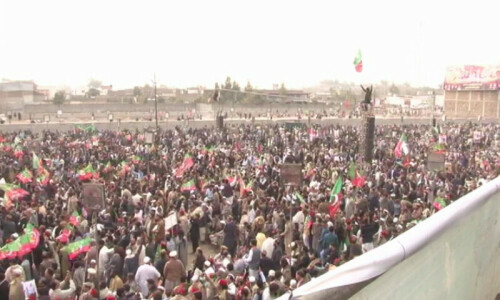
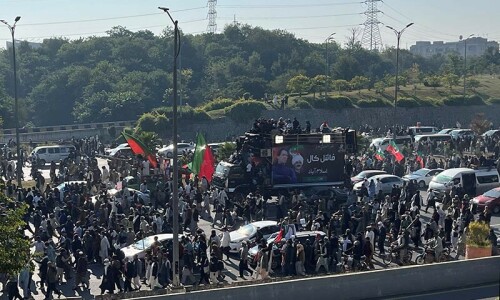
A rally led by the Jeay Sindh Qaumi Mahaz (JQSM) which started from Sukkur culminated outside the Karachi Press Club on Sunday evening, with speakers demanding the end of the six canals project, corporate farming and the alleged forced conversion of Hindu girls among other issues, according to officials, organisers and witnesses.
The demonstrators, who started marching from Sukkur 28 days ago, clashed with police on the main Sharea Faisal near the Finance and Trade Centre (FTC). Some of the protesters allegedly beat police officers, causing traffic on the main artery to grind to a halt.
South Deputy Inspector General Syed Asad Raza told Dawn.com that around 500-600 protesters — women and children among them — arrived at the FTC.
“There was an understanding with leaders of the organisers that from the FTC, they would move towards Lucky Star for their onward journey to the KPC,” Raza said.
“They violated this understanding and started moving towards the old Regent Plaza hotel (now SIUT),” he added. “The policemen deployed there tried to prevent them from moving further.”
Some of the protesters attacked the policemen with stones and sticks, resulting in injuries to the South senior superintendent of police (SSP), his bodyguard, the Saddar police station house officer and other policemen. The protesters also allegedly attacked police and civilian vehicles.
According to a first information report (FIR) filed against the protesters, JSQM leaders allegedly instigated 400-500 demonstrators at the FTC bridge who allegedly attacked police personnel with sticks and stones, injuring eight policemen and damaging three police vehicles.
The FIR alleged that the protesters attacked police vehicles “to fulfil their nefarious designs” and “created fear and panic among the general public and in the area.”
DIG Raza said that since it was “difficult” to disperse the protesters without taking extreme action, police allowed them to proceed towards the press club to avoid any incident.
Police filed the FIR against 12 suspects allegedly leading the demonstration under sections 109 (punishment of abetment if the act abetted committed In consequence and where no express provision is made for its punishment), 144 (joining unlawful assembly armed with deadly weapon), 147 (punishment for rioting), 148 (rioting, armed with deadly weapon), 186 (obstructing public servant in discharge of public functions), 337(i)A (punishment for injuring the head or face), 353 (assault or criminal force to deter public servant from discharge of his duty), and 427 (mischief causing damage) of the Pakistan Penal Code and Section 7 (punishment for acts of terrorism) of the Anti-Terror Act.
At the press club, JQSM leaders including Aslam Khairpur, Niaz Kalani, Ismail Nautkani, Abdul Sattar Channa, Waheed Sindhi, Taj Joyo, Illahi Bux Bikak, Munir Haider Shah, Soriha Sindhi, Maher and others demanded that the federal government halt progress on six proposed canals on the Indus River.
The project has drawn widespread criticism from politicians in Sindh, who allege that it is a ploy to steal water from Sindh and warn that it will drain the province dry. “The six canals project would turn Sindh into a graveyard,” Dr Qadir Magsi, chairman of the Sindh Taraqqi-pasand Party, said at a protest in November.
Environmentalist Zulfikar Ali Bhutto Jr has been a vocal opponent of the canal project. In an interview with Dialogue Earth, he said that the project will exacerbate water shortages, threaten agricultural livelihoods and lead to environmental degradation.
“It will lead to starvation and possibly famine,” he warned. “With climate change already reducing water availability, we are more reliant than ever on the little that remains.”
They also condemned religious extremism and the influx of “outsiders” in Sindh. Activists also called for ending alleged enforced disappearances of political workers of Sindh and their release.
JQSM members also demanded the “expulsion” of law enforcement personnel from educational institutions in Sindh so that students “did not face any “humiliation. “
Some of the speakers said authorities tried to prevent the march near Gora Qabristan (the Christian cemetery), but they “foiled the government’s move” and hailed the rally as a success.