Faiz Festival concludes amid thought-provoking sessions
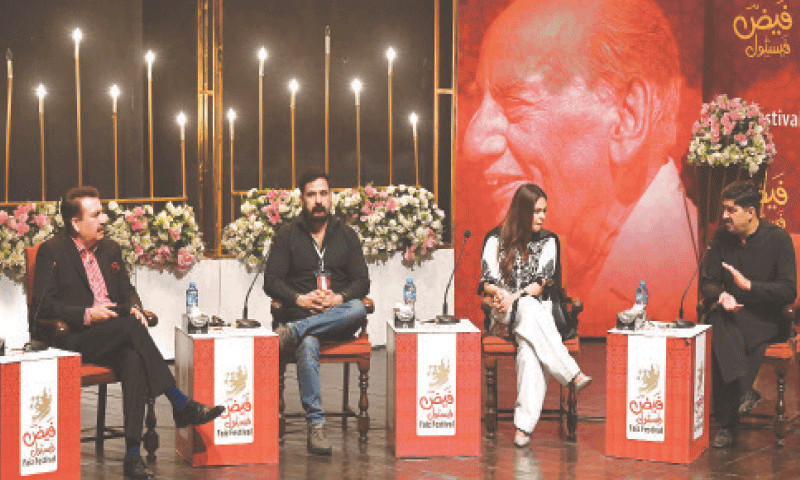

LAHORE: The three-day Faiz Festival, attended by a large of the poet’s fans, concluded here at the Alhamra Art Centre, The Mall, here on Sunday.
On the concluding day, there was a big turnout of visitors from various walks of life and age groups at the festival, who attended different sessions, talks, book launches, poetry sittings and music performances, besides visiting different book stalls set up at the venue.
The Alhamra pavilion was a hot spot where many individuals and families posed for photographs. The festival also featured Open Mic and Drum Circle events which were liked by the visitors a lot. Many youngsters recited Faiz’s poetry at the Open Mic.
Many thought-provoking sessions were held on Sunday. One such session, ‘Journey of TV drama’ moderated by Tauseeq Haider threw light on different periods and shapes of TV drama which continued to evolve with the passage of time.
The panelists at the session were playwright Fasih Bari Khan, director Kashif Nisar and actor Amar Khan. Fasih Bari Khan, sharing his views, regretted that writers were dictated by the channels and producers to write what was popular among the masses and demand the content that should attract a large number of viewers.
He lamented that young writers despite having a lot of talent and depth in their writings were not given chance by the channels as they were not established names. He said the stories of most of the plays were run-of-the-mill kind of stuff which had no novelty. There was a great need to bring change in our TV drama topics and to explore new angles. Khan said the TV plays lacked progressive thinking and newness in the topics.
Director Kashif Nisar while speaking about the difference between OTT platforms and mainstream channels said that what could be shown on OTT could not be shown in TV plays because such plays were being watched by a different audience. He agreed to the view that there were more formula plays with less or no novelty in scripts.
The regressive content in plays is also a major factor in the deterioration of TV drama, he added. Nisar said people who used to produce PTV plays did not have to worry about meeting the cost of the play because the state used to pay them their salaries. Whereas in the case of present day channels, the director has the face the commercial pressure.
Amar Khan was of the view that regressive stuff in TV plays also put pressure on actors as well. She said given the rating race among the channels, there is a viewership pressure on the actors as well, adding that the narrative is important but young writers who were doing so good were not given a chance by the channels to prove their metal.
In another session, titled ‘Politics and Social Media’, moderated by Dr Taimur Rehman, the panelists Syed Muzamil, Uzma Rumi and Faisal Warraich threw light on how social media has developed into a ‘think tank’ itself and how it is influencing people’s opinion at different levels, whether the information it provides is true or false.
Faisal Warraich, speaking about significance of communication tools said social media will be a brutal form of colonialism in near future, adding that the new face of social media was there in the shape of artificial intelligence and robots.
Syed Muzaamil termed social media, an industry worth $300 billion, was a form of ‘technological capitalism’. “It’s a world of illusion,” he said.
He added that information policies have been evolving with the passage of time as earlier print media writers were given great importance, then radio came and voices became important and then came television and now the social media.
Uzma Rumi was of the view that without rationality nations become static. She said people should change with the time as innovations are introduced that compel them to adopt the change.
Published in Dawn, February 17th, 2025