Speakers warn of danger posed by climate change to agriculture

ISLAMABAD: Though climate change is threatening agricultural production, it provides Pakistan with an opportunity to rethink current practices and follow adaptation practices to enhance productivity, said a senior government official.
Speaking at a session of ‘Breathe Pakistan’ international climate change conference organised by Dawn Media, the secretary of Ministry of Climate Change Aisha Humera Chaudhry said adaptation practices had the potential to increase farm productivity by over 50 per cent depending on the crops.
Spelling out various initiatives being undertaken by the government to implement sustainable adaptation processes, she said Pakistan had created 225 wetlands covering 9.7pc of the country’s area. Of this, 20pc is protected and 5pc is forest area.
The secretary particularly mentioned the ‘Water Recharge Pakistan’ project being implemented in four provinces to improve flood protection and water storage capacity.
She said in this regard projects had been established in Dera Ismail Khan, Manchar Lake in Sindh, Chakar Lehri in Balochistan and Taunsa and Ramak in Punjab.
She also highlighted adaptation interventions for agriculture and climate, stating that 14 drought-tolerant wheat varieties and six heat-resistant rice varieties had been introduced in Pakistan.
Research by Pakistan Agricultural Research Council has led to the development of three flood-resistant rice varieties, which can survive submerged conditions for up to two weeks.
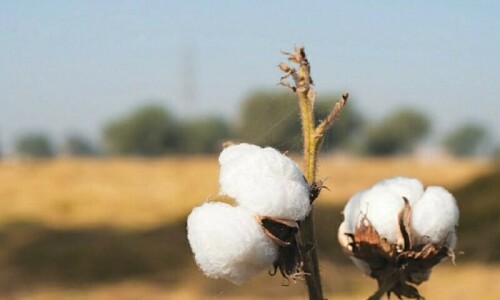
The secretary said some transgenic varieties of maize, cotton, groundnut, wheat, sugarcane and tomato were at experimental stage in Pakistan. These are salt, insect, cold and drought resistant, herbicide and tikka disease resistant.
Speaking at the session, Malik Amin Aslam, a former minister for climate change, said in Pakistan “climate change had gatecrashed into the room, and we do not have the luxury of time at our hands. We do not have time to make plans or strategies to deal with this situation; we are already in a crisis situation.”
He said climate change is no longer about climate talk; it is all about climate action. Pakistan needs to shift the whole development paradigm. Climate change will not be solved unless we make peace with nature. Climate change dealing has to be public centring, and people have to be involved to make an impact, said.

Farmers Association of Pakistan Chief Executive Officer Amalik Afaq Ahmed Tiwana emphasised the need for homegrown solutions instead of borrowed ones to solve the crisis facing the agriculture sector, adding that borrowed solutions will not be sustainable in the long term.
About the free tractors scheme of the government, he said such an amount should be invested in building and improving the infrastructure of farms to ensure water efficiency.
Pakistan Agriculture Coalition CEO Kazim Saeed said Pakistan was among the top 10 countries in terms of agricultural production which can significantly increase its output and export the surplus production.
Discussing the perspective of crop insurance, he favoured insurance of crops, particularly in the scenario of drought and heat which is affecting the crops.
Taimur Malik, co-founder of Drawdown Farm spoke about the biological interventions that can be used to build resilience to climatic shocks.

He said farmers were suffering from climate change since there were many terms and phrases used for the phenomenon of crop yields dropping all over the world due to climate-related events.
Country Director of International Fund for Agricultural Development (IFAD) Fernanda Thomaz Da Rocha talked about the importance of agriculture to Pakistan’s economy, and said it had a contribution of 23pc of the GDP, employing 80pc of the workforce.
She said farmers were the backbone of the agriculture sector, contributing to national food security and export earnings as well.
“Yet, why is it so challenging when we talk about small-scale farmers? They’re among the groups that are most impacted by climate change.”
The IFAD official added that climate change made agriculture uncertain and threatened the natural elements that farmers depended on for production.
“Small-scale farmers were particularly more vulnerable because they had very little capacity to respond to climate shocks.”
Dr Ayesha Khan of Emerging Markets and Climate Finance Specialist at Acumen said her team had set up the first climate equity fund worth $90 million in Pakistan that would be investing in agribusinesses.
She said Pakistan had the third-largest stock of livestock, was the third-largest dairy producer and the fourth or fifth-largest producer of rice.
Published in Dawn, February 8th, 2025