Aeroponics termed future of sustainable agriculture
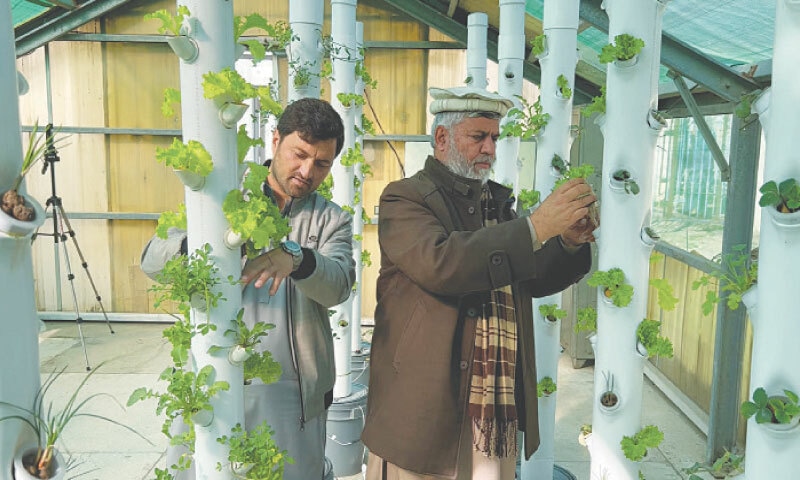

SWAT: Agricultural scientists in Swat region have successfully introduced an innovative method of growing vegetables, known as aeroponics farming, declaring it a breakthrough initiative and the future of sustainable agriculture.
According to them, the pioneering farming technique, developed by agricultural research scientists at the Agriculture Research Institute, Mingora, involves suspending plant roots in plastic pipes and periodically supplying them with essential nutrients and water.
Unlike traditional farming, this method eliminates the dependency on soil, making it possible to grow crops in non-traditional spaces, such as rooftops, balconies, and small courtyards.
According to experts, this technology has the potential to significantly enhance crop yield compared to conventional agricultural practices,” director of the Agriculture Research Centre Swat Dr Roshan Ali told Dawn.
Swat scientists introduce innovative vegetable growing method
He said aeroponics farming required a nutrient-rich liquid solution essential for plant growth.
“The nutrient-infused water is delivered to the plant roots through a pipe, powered by a small motor. This ensures that the plants receive the necessary nutrients for optimal growth,” he said.
Dr Ali also highlighted one of the key advantages of aeroponics farming, emphasising its health benefits.
“This method produces fresh and healthy vegetables as it utilises clean and purified water, unlike traditional ground farming, where plants may absorb heavy metals that are harmful to human health,” he said.
The director noted that aeroponics farming had already been widely adopted in modern agriculture worldwide, but his centre had only recently introduced it as part of its efforts to promote sustainable and innovative farming practices in the region.
Zakaria Bacha, a research officer at Swat ARI and a PhD student at the University of Agriculture, Swat, who led the initiative, said that aeroponics offers a viable solution for farmers and urban dwellers, who lacked sufficient land for traditional farming.
He said vertical farming required less space but produced higher yields.
“With aeroponics, plants receive direct access to vital nutrients in a controlled environment, leading to faster growth and higher production. This method not only ensures efficient resource utilisation but also minimises risks associated with soil-borne diseases,” he said.
Swat Valley, known for its fertile lands and rich agricultural heritage, is facing increasing challenges due to population growth and urban expansion. The availability of arable land is shrinking, making sustainable and space-efficient farming methods essential for future food security.
“By adopting this technology, people can cultivate fresh vegetables and crops within limited spaces while ensuring higher productivity, reduced water consumption, and minimal environmental impact,” he said.
He further said the breakthrough in soilless agriculture aligned with global efforts to promote sustainable farming practices.
“Aeroponics not only conserves land but also uses 90 per cent less water compared to traditional soil-based farming, making it a crucial alternative for areas prone to water shortages,” he said.
Zakaria Bacha said he believed that aeroponics farming would soon become a popular choice among farmers and urban residents in Pakistan.
“This technique is scalable and adaptable, making it an ideal solution for both large-scale agricultural enterprises and small home-based setups. With proper support and awareness, we can revolutionise the way farming is done in Swat and beyond,” he added.
Agricultural experts said as climate change and land scarcity continued to challenge conventional farming methods, aeroponics technology could be the key to ensuring sustainable food production in Pakistan’s rapidly urbanising regions.
They said with continued research and government support, that innovation could reshape the future of agriculture in Swat Valley and across the country.
Published in Dawn, February 2nd, 2025