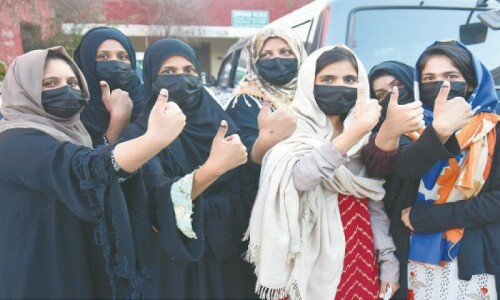
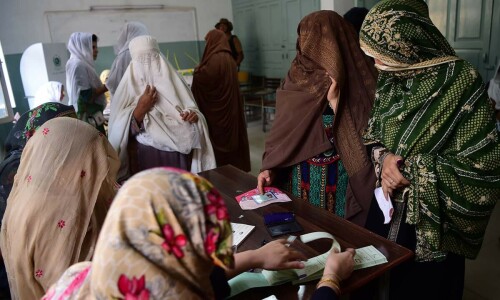
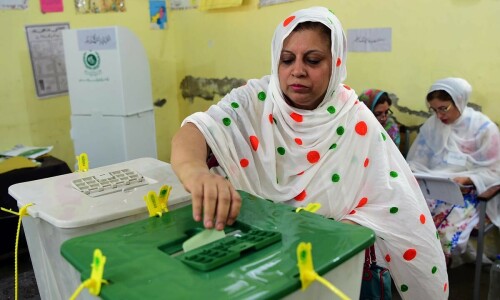
Women voters’ choice in 18 per cent of communities — in the jurisdiction of male and female polling stations — differed from that of their male counterparts in last year’s general elections, according to a report by the Free and Fair Election Network (Fafen) released on Sunday.
A total of 60.8 million voters exercised their right to vote in Pakistan’s general elections on February 8 last year, according to a Dawn.com analysis.
While women’s share in the votes cast increased compared to the 2018 elections, the voter turnout witnessed a second consecutive decline, highlighting widespread “apathy”.
“Women voters in 18 per cent of communities in the jurisdiction of male and female polling stations voted differently from their male counterparts in National Assembly constituencies during general elections (GE) 2024,” stated a Fafen press release on the report.
In an analysis, titled ‘Women’s Voting Choices: Significance and Impact on Electoral Outcomes’, Fafen compared the results of male and female polling stations in the same communities.
“In 18pc of the communities, male and female voters diverged in their choice of winner as they returned different winners from their respective polling stations,” the press release said.
“Compared to rural areas, communities in urban areas showed more divergent choices among male and female voters,” it added.
Meanwhile, in the rest of the 82pc of the communities, male and female voters’ choice of winner was aligned as they returned the same winner from their respective polling stations, the report added.
However, Fafen highlighted that since election results of combined polling stations did not provide a gender-wise breakdown of how male and female voters vote, the analysis could only compare the results of male and female polling stations.
Furthermore, it limited its scope to male and female polling stations where men and women from the same electoral areas voted. The assessment included 21,188 communities comprising 42,804 comparable male and female polling stations.

PTI leads in winning more support from women countrywide
Of the 3,884 communities where women’s choice of winner for National Assembly seats was different, the PTI won more support from women in 1,260 communities (32pc), followed by the PML-N in 1,027 (26pc), and the PPP in 694 (18pc).
According to Fafen, regional trends showed that while the PTI performed well across the country in terms of women voters’ choice, the PML-N remained strong in Punjab, winning more votes from women in 895 communities.
It further stated that the PPP dominated in Sindh, getting more winning ballots from female voters in 413 communities, the majority.

Region-wise breakdown; women’s impact on results
According to the analysis, among regions, the Islamabad Capital Territory (ICT) had the highest proportion (37pc) of electoral communities with different winners in male and female polling stations.
Balochistan reflected a “smaller but notable contrast”, with 68pc of its communities aligned in their winning choices and 32pc differing. It was followed by Sindh (19pc) and Punjab (18pc), while Khyber Pakhtunkhwa had the lowest proportion (13pc) of such electoral communities.

The Fafen analysis also shed light on the significance of women’s choices in determining constituency results.
In 37 NA constituencies, the largest proportion of voters in female polling stations did not vote for the winning candidates, it highlighted. Meanwhile, in 226 NA constituencies, the largest proportion of voters in female polling stations voted for the constituency winner.
In seven constituencies — NA-43 Tank-cum-Dera Ismail Khan, NA-49 Attock-I, NA-55 Rawalpindi-IV, NA-87 Khushab-I, NA-94 Chiniot-II, NA-128 Lahore-XII, and NA-163 Bahawalnagar-IV — the lead at female polling stations determined the winner.