JENIN: Hundreds of people began leaving their homes in a flashpoint area of the occupied West Bank on Thursday as Israeli forces pressed a deadly operation.
The Israeli military launched the raid in the Jenin area, days into a ceasefire in the war with Hamas in the Gaza Strip.
“Hundreds of camp residents have begun leaving after the Israeli army, using loudspeakers on drones and military vehicles, ordered them to evacuate the camp,” Jenin governor Kamal Abu al-Rub told AFP.
The Israeli army said it was “unaware of any evacuation orders for residents in Jenin as of now”. Since it began on Tuesday, the operation has killed at least 12 Palestinians and wounded 40 more, according to the Palestinian health ministry.
“There are dozens of camp residents who have begun to leave,” Jenin resident Salim Saadi said. “The army is in front of my house. They could enter at any moment.”
Gazans ready tent camps for families returning to north after ceasefire
Israeli forces have also detained several Palestinians from the Jenin area, with an AFP photographer seeing a row of blindfolded men in white jumpsuits being transported out of the West Bank.
Palestinians had already begun fleeing the Jenin area on foot on Wednesday, with AFPTV images showing a group of men, women and children making their way down a muddy road, the sound of drones buzzing above them clearly audible.
The Israeli military said on Thursday it killed two Palestinian fighters near Jenin during the night, accusing them of having killed three Israelis.
The Palestinian health ministry later confirmed the two deaths.
Meanwhile, an Israeli tank killed two Palestinians west of Gaza’s Rafah on Thursday, the Gaza civil defence said.
Tent camps
Palestinians in northern Gaza prepared tent encampments for displaced families on Thursday, two days before they were expected to return to their home areas in accordance with the timeline of a ceasefire deal agreed between Israel and Hamas.
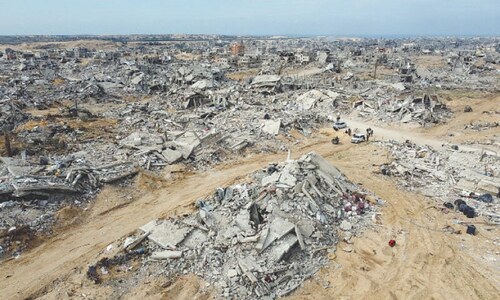
On open ground surrounded by blown-out buildings, a group of men began putting up rows of white tents to receive families who are planning to return north on Saturday when the Palestinian group Hamas is due to release a second batch of prisoners in return for dozens of Palestinians jailed by Israel.
Many of the hundreds of thousands of Palestinians expected to head back to the northern Gaza Strip will return to homes in ruins after a 15-month Israeli military offensive that has laid waste to the enclave and killed more than 47,000 Gazans.
“Is this the tent that we dreamed of? This will have to fit 10 people. This tent is for my children coming from the south. Really, is this adequate space?” asked Wael Jundiya, as he prepared a tent for his children who will return from where they have been sheltering in the Mawasi coastal area of the south.
“On Saturday, people will come from the south and flood Gaza (City), where will they go? This camp will fit 100, 200 people. There will be 1.5 million coming from the south,” Jundiya told Reuters.
Hamas published a statement on Thursday saying the return of the displaced families would begin after Saturday’s exchange was complete and once Israeli forces had pulled out from the coastal road to the north. At least four prisoners are expected to be handed over to Israel on Saturday.
Hamas said people would be allowed to return on foot along the coastal road, meaning a walk of several miles to the official northern area from where they could try to get rides in vehicles, which would be searched at checkpoints. People returning must not carry arms, Hamas said.
Senior Hamas official Sami Abu Zuhri said the group was in contact with several Arab and international parties who would assist in the return and relief operation, including providing tents. He said Hamas would start work immediately to repair houses not fully destroyed.
“We are going to invest all our capabilities to help our people. Municipalities have plans in place to welcome the families returning to the north, including setting up tents for them,” he told Reuters.
In Jabalia, the biggest of the Gaza Strip’s eight historic refugee camps, and the focus of Israel’s campaign in the past three months, many have returned to live inside their wrecked homes, setting small fires to try to warm their children.
Published in Dawn, January 24th, 2025