0
0

ISLAMABAD: The Supreme Court has deferred until Monday deliberations on the issue of whether regular benches can determine the constitutionality of Article 191A, which had established the constitutional bench through the 26th amendment.
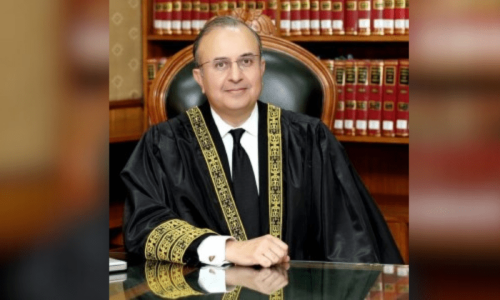
A three-member bench, headed by the senior puisne judge of Supreme Court, Justice Syed Mansoor Ali Shah, decided to deliberate on the matter on Jan 20 following a change in the bench’s composition, with Justice Aqeel Ahmed Abbasi replacing Justice Irfan Saadat Khan as its third member, who was previously part of the court when the issue initially cropped up.
In a brief order on Thursday, Justice Shah directed that the matter be placed before the same bench consisting of himself, Justice Ayesha A. Malik and Justice Irfan Saadat Khan — the bench that had heard the case earlier.
Justice Shah dictated that the case was heard by a different bench when it was posted for Thursday. But the bench stands reconstituted, therefore the case will again be taken up on Monday by the same previous bench at 11:30am since the matter was partly heard.
Besides, Justice Abbasi had already heard the main petition when he was a member of the Sindh High Court (SHC), the order said.
Justice Abbasi is a member of the original bench, but since he was on leave for a few days, Justice Khan had replaced him. Now Justice Khan will be part of the bench when the matter will be taken up on Monday.
When, during the hearing, Additional Attorney General Chaudhry Aamir Rehman requested for more time for preparation, Justice Malik wondered if the federation was not well prepared.
Senior counsel Salahuddin Ahmed, who represents the respondents, however, said that he was prepared and can argue.
The issue arose on Jan 13 when the bench had taken up the federal government’s petition against the SHC decision of striking down Section 221-A(2) of the Customs Act, 1969.
Then the matter cropped up whether Article 191A infringes upon the salient features of the constitution, including the independence of judiciary and separation of powers among the three organs of the state and whether a regular bench can decide the question of the constitutional validity of Article 191A when an objection to its jurisdiction was raised on the basis of the article.
Last Monday, the petitioners drew the court’s attention that the regular Supreme Court bench cannot hear such cases, as they involve challenges to the constitutionality of laws, specifically Section 221-A(2) of the Customs Act.
At this, Justice Shah had stressed the need for resolving the controversy over the question of constitutional interpretation by the judges.
In response to the petitioners’ objection regarding the present bench’s lack of jurisdiction, advocate Salahuddin Ahmed argued that Article 191A — the basis of the jurisdictional objection — was constitutionally invalid as it violated the salient features of the Constitution, including judicial independence and separation of powers among the three organs of the state.
Mr Ahmed, who has also challenged the vires of the 26th amendment before the apex court, argued that a constitutionally invalid amendment cannot override the constitutionally valid conferment of jurisdiction on the regular benches.
Published in Dawn, January 17th, 2025