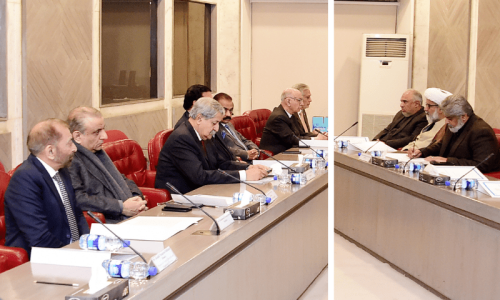
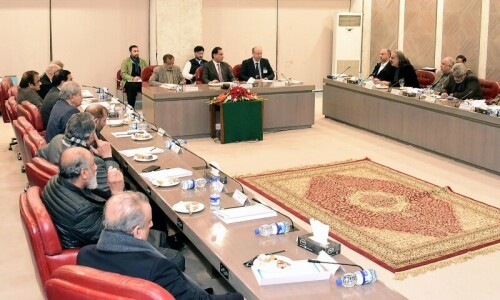
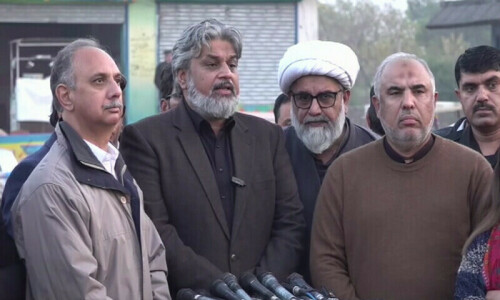
THERE’S a welcome chill in the political atmosphere as talks proceed between the government and the PTI over several outstanding issues. The groundbreaking for negotiations appears to have been done, with two meetings held in recent weeks, of which the latest is said to have concluded on a positive note. Another huddle is expected next week, once the PTI consults with its incarcerated founder to finalise its charter of demands for the government. If parleys begin in earnest, January could prove an important month: the PTI has previously stated that it wants negotiations to conclude before February.
It appears that the party may stick to two initial demands: the release of its workers, incarcerated in various cases, and a judicial commission to probe the events of May 9, 2023, and November 26, 2024. Though these have yet to be presented in writing, it seems the bar is low enough for the government to engage without incurring political costs.
It is encouraging also to note that the participants of these meetings have an eye on the bigger picture. According to a statement attributed to the National Assembly speaker, all participants have agreed to engage in dialogue for the country’s betterment, “covering issues such as the economy, terrorism, and other critical matters.” This is just as well because though some measure of economic stabilisation has now been achieved, the growth needed to support the country will remain elusive till political stability returns.
In a recent meeting of the Special Investment Facilitation Council, the prime minister observed that the strength of any economy is rooted in its political framework and that Pakistan’s development is, therefore, directly linked to its political stability. Though Pakistan has secured memoranda of understanding worth billions of dollars with various countries, it will have great trouble realising them till the persistent uncertainty in the political equation is eliminated.
Regardless of the intentions of the negotiators, however, there remain many little hurdles in the way of a political resolution. The representatives in the dialogue committee, for example, cannot achieve anything on their own: they will need validation from the heads of their respective political parties at each step of the process.
Such hurdles could, of course, be swiftly cleared if the heads of the PTI, PML-N and PPP were to sit down and work out a modus vivendi directly with each other. The biggest barrier is the seeming inability of the opposition and government to come to terms with their respective situations. It remains vitally important for stakeholders to acknowledge and understand that politicians can still challenge opposing parties’ narratives without also being in a constant state of war with each other. It is hoped and prayed that this realisation hits home sooner rather than later.
Published in Dawn, January 4th, 2025