South Korea says will send Jeju Air crash black box to US


South Korean investigators probing a Jeju Air crash which killed 179 people in the worst aviation disaster on its soil said Wednesday they will send one of the retrieved black boxes to the United States for analysis.
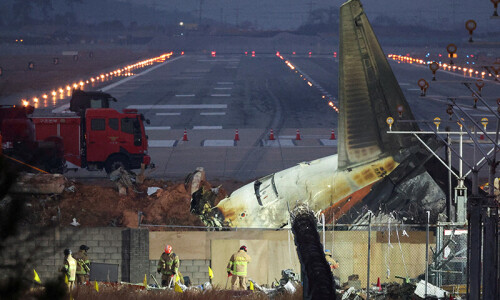
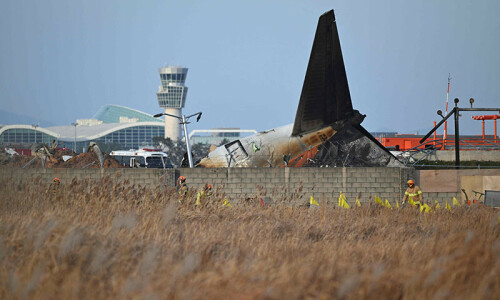
The plane was carrying 181 people from Thailand on Sunday when it issued a mayday call and belly-landed before hitting a barrier and bursting into flames, killing everyone aboard except two flight attendants pulled from the burning wreckage.
South Korean and US investigators, including from Boeing, have been combing the crash site in southwestern Muan since the disaster Sunday.
“The damaged flight data recorder has been deemed unrecoverable for data extraction domestically,” said South Korea’s deputy minister for civil aviation, Joo Jong-wan.
“It was agreed today to transport it to the United States for analysis in collaboration with the US National Transportation Safety Board.” Joo earlier said both of the plane’s black boxes were retrieved, and for the cockpit voice recorder, “the initial extraction has already been completed”.
“Based on this preliminary data, we plan to start converting it into audio format,” he said, meaning investigators would be able to hear the pilots’ final communications.
The second black box, the flight data recorder, “was found with a missing connector”, Joo said.
“Experts are currently conducting a final review to determine how to extract data from it.”
Officials initially pointed to a bird strike as a possible cause of the disaster, but they have since said the probe was also examining a concrete barrier at the end of the runway, which dramatic video showed the Boeing 737-800 colliding with before bursting into flames.
They also said that a special inspection of all Boeing 737-800 models operated by local carriers was examining their landing gear after questions over a possible mechanical failure in the crash.
The ongoing inspections are “focusing mainly on the landing gear, which failed to deploy properly in this case”, said the director general for aviation safety policy, Yoo Kyeong-soo.
Local media reported the landing gear had deployed properly on Jeju Air Flight 2216’s first failed landing attempt at Muan airport before failing on the second.
The issue “will likely be examined by the Accident Investigation Board through a comprehensive review of various testimonies and evidence during the investigation process”, the ministry of land, which oversees civil aviation, said at a briefing.
All victims identified
At Muan airport, grieving families of victims had become increasingly frustrated by delays in identifying and releasing the bodies.
Officials have said the bodies were extensively damaged by the crash, making the work of identifying remains slow and immensely difficult, even as investigators had to preserve crash-site evidence.
But the country’s acting president Choi Sang-mok, who has been in office less than a week, said Wednesday the process had finally been completed, and that more bodies had been handed over to relatives so that they could hold funerals.
“Our investigators, along with the US National Transportation Safety Board and the manufacturer, are conducting a joint investigation into the cause of the accident,” Choi said at a disaster response meeting Wednesday.
“A comprehensive analysis and review of the aircraft’s structure and the black box data will reveal the cause of the accident,” Choi added.
The US investigators had arrived Monday and headed straight to Muan, with the initial on-site joint probe focusing on a navigation system known as a localiser that assists in aircraft landings.
The localiser, installed on a concrete structure at Muan International Airport, is the barrier that has been blamed for exacerbating the severity of the Jeju Air crash.

The plane was largely carrying holidaymakers back from year-end trips to Bangkok, with all passengers Korean nationals except for two Thais.
A fuller account of what went wrong in the flight’s final moments is expected once authorities have analysed the black boxes.
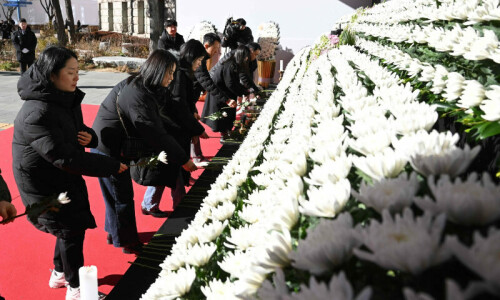
Memorial altars for the victims have been set up nationwide, including in Seoul and at Muan airport.