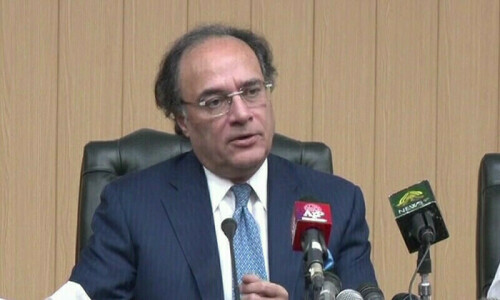
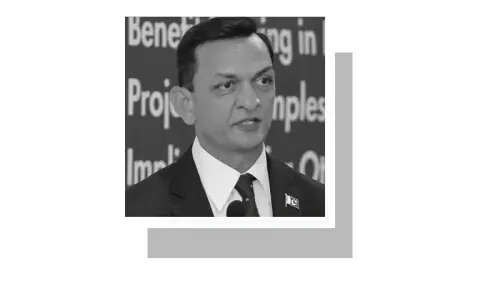
Finance Minister Muhammad Aurangzeb on Sunday said that the government was committed to building on the hard-earned macro-stability to further strengthen the economy of the country, adding that “prudent economic policies” had led to substantial improvements.
Talking to the media in Islamabad on Sunday, he cited recent figures related to decreasing inflation and the surging foreign exchange reserves, saying that the government’s “prudent economic policies” had resulted in significant improvements.
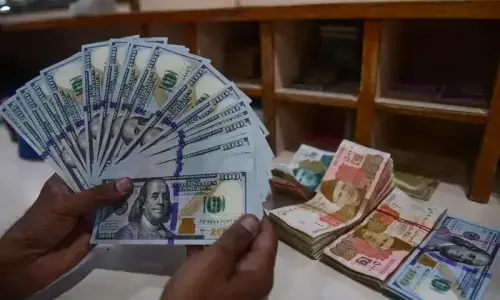
“[There is a] reduction of inflation from 38 per cent to just seven per cent and the policy rate from 22pc to 15pct, while foreign exchange reserves have surged from two weeks of import cover to 2.5 months of import cover,” he said, according to state broadcaster Radio Pakistan.
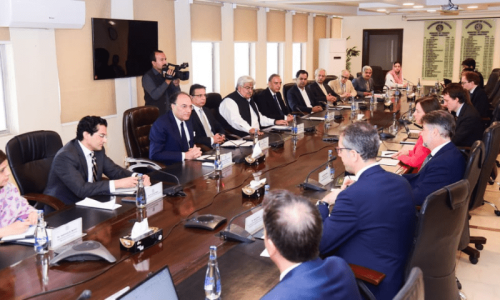
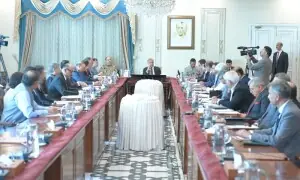
Providing details about the discussions that took place between the Pakistani delegation and the various multilateral institutions during his visit to Washington DC in October, he said: “The international community, financial institutions, and rating agencies had commended the government’s efforts in leading the country’s economy from deficits to surpluses.”
He also mentioned that he engaged with his counterparts from various countries, including the United Arab Emirates (UAE), Saudi Arabia, China, Turkiye, and officials of the US treasury, while he also met up with officials of various rating agencies.
The finance minister said, “We were given a platform there to share with the comity of nations about how we achieved this turnaround in just 14 months.”
Talking about the recent visit of the International Monetary Fund (IMF) delegation to Pakistan, he said it is an ongoing dialogue process, and discussions were held on energy and SOE reforms, the privatisation agenda, and public finance.
“Such interactions and discussions are vital for mutual credibility and trust,” he said. “We have shared with the IMF our commitment towards the rightsizing of the federal government.”
The finance minister’s speech comes days after the IMF staff’s visit to Pakistan from Nov 12 to Nov 15.
The global lender on Saturday had said it agreed with the Pakistani government on the need to transfer “greater social and development responsibilities to provinces”.
The unscheduled visit discussed a $7-billion bailout within six weeks of its approval by the IMF board, but came too early for the first review of the Extended Fund Facility (EFF), due in the first quarter of 2025.
Firm compliance on taxation
Regarding revenue and taxation, he said the government was firm on compliance and enforcement and every sector will have to play its due role in this regard.
“The discussions with the IMF were very positive on the matter of revenue and taxation,” he said.
Earlier this month, the finance czar had admitted that the salaried class was already overburdened, saying that increasing taxes was not a solution, rather the expansion of the tax net should be the ultimate goal.
“Countries do not and cannot run on charity or donations,” he had said, adding that the economy needed taxes to sustain long-term growth.
He admitted, however, that these segments were already beyond the saturation point. “We cannot afford to tax more the same [classes] who have been taxed at a level which is not sustainable anymore,” he had said.
Existential issues
The minister also emphasised the need to talk about the existential issues facing the country which he said included “unchecked population growth and the climate emergency.”
“Someone said this yesterday as well and I endorse it that this is not only a charter of the economy but a charter of the environment as well.”
Aurangzeb said, “This is not something we can take consequentially. Today, we are asked about the IMF — however, we don’t take population and climate resiliency [even though] they are as important.”
He called upon everyone to treat these issues with the same urgency.