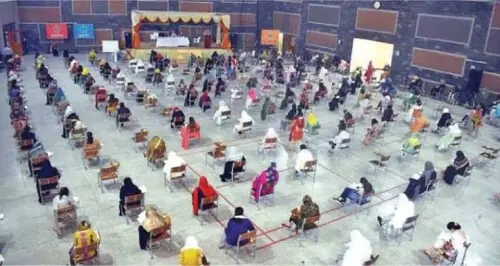
KARACHI: The third Chaak Urdu Afsana Conference kicked off on Friday, where academics and Urdu writers discussed various aspects of Urdu short stories, the writers of this form and its practice in the present time.
The two-day event has been organised by the Chaak Adabi Forum at the KMC Sports Complex.
The event’s opening session was presided over by writer Akhlaq Ahmed and the chief guest of the event was Dr Syed Saifur Rehman, director general of the National Institute of Public Administration, while other speakers were Tehmina Abbas and Saima Sameem.
The main topic in the session was the war in Palestine and Urdu short story form, where the speakers explored various aspects of how literature responded to wars in the history and how it could do so in the context of the war in Gaza.
Dr Syed Saifur Rehman highlighted the importance of the study of social sciences, particularly literature, and said it could make an impact on society and help improve lives of individuals in ways that science could not, and therefore, literature and its study by the younger generation was of crucial importance.
Two-day Chaak Urdu Afsana Conference begins
Mr Ahmed spoke about how difficult it was to print and sell Urdu literature books at present as the readers of the printed books were constantly decreasing. He also suggested that the writers of Urdu short stories needed to update themselves to modern practices in order to retain their readership.
The second session was on Urdu translations of Japanese literature, focusing particularly on the works of late Nikhat Hasan who translated works of Nobel Laureate Yasunari Kawabata from English into Urdu. The session was moderated by a journalist and writer, Khurram Sohail.
Lubna Hasan, who is Nikhat Hasan’s daughter and lecturer at the Department of English, University of Karachi, spoke about her mother’s translations of Kawabata’s works into Urdu. She said Nikhat Hasan had a strong interest in the practice of translation; she translated Kawabata’s works as she liked his writing style.
She said her mother had translated a short-story collection of the Japanese writer, Palm of the Hand as Kaf-i-Dast and his novel Beauty and Sadness as Husn-o-Huzn in Urdu.
Dr Faisal Nazir, Nikhat Hasan’s son-in-law and assistant prof at KU’s Department of English, discussed aspects of Nikhat novel Jogging Park and read passages from it besides highlighting other aspects of her works and personality.
“Nikhat Hasan had a quiet personality but when you read her works, especially Jogging Park, you find that it was very powerful and full of intensity.”
A writer and teacher of Japanese language, Syed Shuja Haider, shared his experience of teaching that language and his experiences in Japan, highlighting the high esteem for teachers in that society.
The speakers also paid rich tributes to Nikhat Hasan.
Published in Dawn, November 16th, 2024