SEOUL: South Korean military has said Pyongyang once again staged GPS jamming attacks, affecting several ships and dozens of civilian aircraft in Seoul.
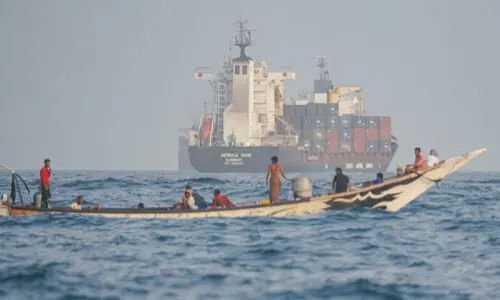
“North Korea conducted GPS jamming provocations in Haeju and Kaesong yesterday and today,” Seoul’s joint chiefs of staff said in a statement on Saturday, adding several vessels and dozens of civilian aircraft were experiencing “some operational disruptions”.
The military warned ships and aircraft operating in the Yellow Sea to beware of such attacks.
“We strongly urge North Korea to immediately cease its GPS provocations and warn that it will be held responsible for any subsequent issues arising from this,” they warned.
Pyongyang asked to immediately cease its ‘provocations’
The jamming allegations come about a week after the North test-fired what it said was its most advanced and powerful solid-fuel ICBM missile, its first such launch since being accused of sending soldiers to help Russia fight Ukraine.
In a show of force aimed at demonstrating its resolve to respond to “any North Korean provocations”, the South fired its own ballistic missile into the sea on Friday.
Relations between the two Koreas are at one of their lowest points in years, with the North launching a flurry of ballistic missiles in violation of UN sanctions.
It also has been bombarding the South with trash-carrying balloons since May, in what it says is retaliation for anti-Pyongyang propaganda missives sent North by activists.
The South Korean military said Pyongyang also attempted to jam GPS signals in May, but added at the time that it did not hinder any military operations in the South.
In Friday’s drill, South Korea fired a Hyunmoo surface-to-surface short-range missile into the West Sea, which the military said was to show Seoul’s “strong resolve to firmly respond” to any North Korean threats.
The Hyunmoo missiles are key to the country’s so-called ‘Kill Chain’ preemptive strike system, which allows Seoul to launch an attack if there are signs of an imminent North Korean attack.
‘Real risk’
Experts say such jamming attacks can lead to other incidents that could escalate tensions on the Korean peninsula.
“It remains unclear whether there is an intention to divert the world’s attention from troop deployments, instil psychological insecurity among residents in the South, or respond to Friday’s drills,” Yang Moo-jin, president of the University of North Korean Studies in Seoul, told AFP.
“However, GPS jamming attacks pose a real risk of serious incidents, including potential aircraft accidents in the worst-case scenario.”
Ahn Chan-il, a defector-turned-researcher who runs the World Institute for North Korea Studies, told AFP the North’s jamming could be “to shield their own communications and intelligence exchanges during critical military operations” both at home and abroad.
Published in Dawn, November 10th, 2024