WASHINGTON: Finance Minister Muhammad Aurangzeb has said that the China-Pakistan Economic Corridor (CPEC) has transitioned from a government-to-government investment model in its first phase to a business-to-business engagement in its second phase.
He made these remarks in an interview with the US edition of China’s CGTN network. He previously indicated that Pakistan could repay its Chinese debt only after successfully completing CPEC’s second phase.
During his interview with CGTN, the minister described CPEC as the “champion project” of China’s Belt and Road Initiative, noting that significant infrastructure — particularly road networks and ports — was developed during the first phase.
He underscored the importance of CPEC’s second phase and highlighted Pakistan’s anticipation of increased Chinese investment to support this stage. He thanked the Chinese government and banks for their assistance in debt rollovers, while acknowledging the need for eventual repayment, affirming Pakistan’s commitment to fulfilling its financial obligations.
Sees engagement shift to business-to-business model
In a separate meeting on Saturday with China’s Vice Minister of Finance, Liao Min, Mr Aurangzeb reaffirmed Pakistan and China’s enduring strategic cooperative partnership. He expressed gratitude for China’s steadfast support in Pakistan’s socio-economic development and its role in securing the IMF’s Extended Fund Facility (EFF).
Energy challenges
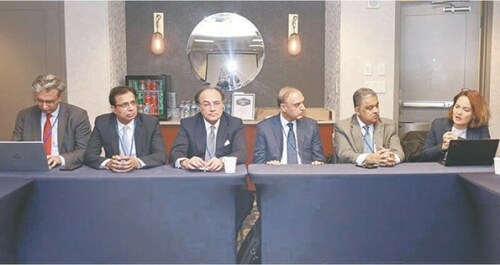
On his fifth day in Washington, attending the annual meetings of the International Monetary Fund (IMF) and the World Bank Group, Mr Aurangzeb engaged in high-level meetings with key international stakeholders, including US officials and representatives from leading financial institutions like the IMF and World Bank.
In a meeting with US Assistant Secretary of State for Energy Resources Geoffrey Pyatt, Mr Aurangzeb discussed Pakistan’s energy sector challenges and the comprehensive reforms being introduced. He appreciated US support in helping Pakistan transition to renewable energy sources.
Separately, he also met with Reta Jo Lewis, President of the Export-Import (EXIM) Bank of the United States. He encouraged closer collaboration and, welcomed EXIM’s interest in Pakistan’s energy, minerals, and IT sectors, and assured provision of necessary data to facilitate the bank’s market entry evaluation. Additionally, he sought clarification on US nexus requirements for goods and services financed or insured by EXIM Bank.
Mohammad Kallala, Global Head of Corporate and Investment Banking at Natixis, met with Mr Aurangzeb to discuss Natixis’ operations, focusing on its strong presence in infrastructure, renewable energy, transportation, aviation, and telecom/technology sectors.
They explored potential partnerships with Gulf investors, particularly from Saudi Arabia, to provide financing and advisory support for investments in Pakistan.
In another meeting, Karan Bhatia, Vice President and Global Head of Government Affairs and Public Policy at Google, provided an overview of Google’s recent activities in Pakistan, along with its plans to expand investments and contribute substantially to the country’s economy. To support these initiatives, Bhatia raised regulatory, legislative, connectivity, and financial concerns.
Ratings upgrade
Mr Aurangzeb also held discussions with representatives from Moody’s credit rating agency, where he expressed appreciation for the recent upgrade of Pakistan’s credit rating to Caa2.
He highlighted the Ministry of Finance and the central bank’s ongoing engagement with rating agencies.
The meeting included a detailed briefing on Pakistan’s debt sustainability, monetary policy, vulnerability to external factors, foreign exchange reserves, fiscal discipline, revenue outlook, governance strength, and resilience of financial markets.
APP ADDS: During a meeting with representatives of S&P Global, the minister expressed the hope of a rating upgrade soon.
In a meeting with ADB President Masatsugu Asakawa, he appreciated ABD’s partnership to support Pakistan’s development agenda and hoped the Country Partnership Framework would be finalised soon.
Published in Dawn, October 27th, 2024