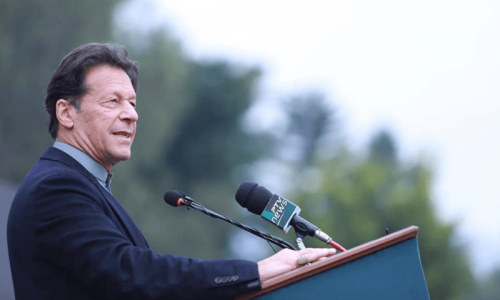
AMONG the various things that lately have not gone Imran Khan’s way was his predictable elimination from the list of candidates for the post of Oxford University chancellor.
The absurdity of applying for the position would only be compounded if he or one of his advisers were to pursue legal proceedings querying the rejection.
The exclusion criteria state that a nominee “cannot be a serving member of, or a declared candidate for election to, an elected legislature”. The obvious implication is that Imran would have been obliged to abandon all his domestic political ambitions to qualify as a candidate.
Writing in Middle East Eye last month, the contrarian British journalist Peter Oborne declared that the PTI “embodies the exact values of freedom and justice Khan learned as a student of politics and economics at Oxford’s Keble College 50 years ago”. Oxford’s shortcomings notwithstanding, equating its values to those of the PTI constitutes a grievous affront to the university — and echoes the sheer ignorance of the Times of Israel blogger Aynur Bashirova, who claims that “Khan has previously shown a willingness to challenge the status quo, particularly in areas like education reform and women’s rights”. Pakistani feminists and educationists might disagree.
Bashirova’s comment focuses more on Imran’s reported outreach to Israel via his erstwhile Goldsmith in-laws, while Oborne approvingly cites a single comment on Gaza, contrasting it with the silence of other nominees for the Oxford chancellorship, such as former Tory leader William Hague and Labour minister Peter Mandelson.
Oborne’s endorsement has been challenged by the likes of The Observer‘s Catherine Bennett, who denounced Imran’s candidacy as an insult to “Oxford’s female students, past and present” and as a potential gift to “the Taliban and its apologists”, and more recently by Kapil Komireddi.
Who qualifies as Oxford chancellor?
In a column for the Daily Telegraph last week, he wondered whether its alumni and staff were “ready to drag Oxford out of a millennium of darkness and make it an inclusive institution by voting for a candidate who lauded the resurrection of the Taliban … as a ‘blessing…’?” He goes on to spell out Imran’s other inadequacies — lately enhanced by his acolytes in the Pakistani-American Public Affairs Committee endorsing a proto-fascist in a rather more consequential election.
Segments of the Western left inexcusably continue to consider Imran a martyr in the anti-imperialist cause rather than a player in a sordid political game who managed to antagonise too many of his team-mates and sponsors. They fail to recognise that his persecution and prosecutions can be opposed in principle without endorsing his obscurantist ideology.
The publicity his hopeless bid attracted, alongside the change of university rules, has likely played a role in attracting an inordinate number of candidates from South Asia with no previous connection to the university, or evidently much idea of what the largely ceremonial, and unremunerated, role of chancellor involves.
Among the 38 candidate statements posted on the university website, Sidra Aftab, a lawyer from Lahore, boasts an “ability to understand the true facts of circumstances and to deal with daunting deadlines”; another legal eagle, Anwar Baig, considers himself a “well and fit person for this job”; Kashif Bilal vows to “Enhance literacy rate in UK and global world”; Supreme Court advocate Aftab Ahmad Javaid Sheikh lays claim to the position based on “the dynamic experiences” of his life; Kashmaila Rauf considers her experience as Amazon team leader an adequate qualification; Abrar ul Hasan Shapoo restricts his ambitions to “working with honesty and welfare of the university”; Tanya Tajik says her Zumba experience would “help me manage respon-sibilities of a Chancellor”.
Ex-politicians (who have hitherto tended to win the post) in the fray include former Tory leader William Hague and his ex-colleague Dominic Grieve (the only candidate on whose behalf I have been canvassed) and New Labour stalwart Peter Mandelson. Based on the precedence of former British politicians winning the gig, one of them is the likeliest successor to Chris Patten.
This is the first time the vote has been thrown open to the ‘convocation’ — including all former alumni — rather than restricted to the ‘congregation’, a terminology that points to Oxford’s origins almost a millennium ago as a theological seminary, reflected in its motto Dominus illuminatio mea (the Lord is my light).
Anyone wanting a different motto might have earned my endorsement. As things stand, I have no idea whom I’ll vote for when the ballot goes live next week. But, beyond Imran Khan’s absence from the list, it’s also reassuring that it doesn’t particularly matter who wins this sordid (or morbid) contest.
Published in Dawn, October 23th, 2024