0
0

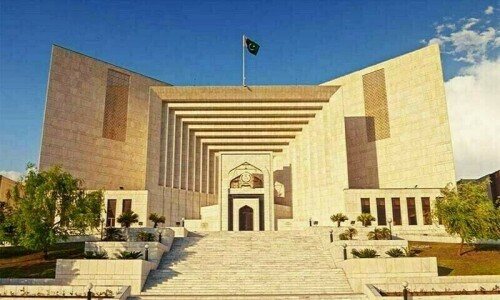
On the heels of the 26th Amendment’s passage, Justice Mansoor Ali Shah on Monday remarked that the question of jurisdiction would “arise every day” in the Supreme Court (SC) following legislation on constitutional benches.
In the early hours of Monday, the much-awaited 26th Constitutional Amendment became law after approval of both houses of the Parliament, which was then given assent by President Asif Ali Zardari.
The 26th Amendment brings changes to the Constitution, most of which pertain to the judiciary. Some main reforms include taking away the Supreme Court’s suo motu powers, setting the chief justice of Pakistan’s (CJP) term at three years, and empowering the prime minister to appoint the next CJP from among the three most senior SC judges.
The greatest number of amendments are to Article 175A, which deals with the process of appointment of judges to the Supreme Court, high courts and the Federal Shariat Court (FSC).
Under amendments proposed to clause 3 of Article 175A, instead of the president appointing the “most senior judge of the Supreme Court” as the CJP, the top judge will now be “appointed on the recommendation of the Special Parliamentary Committee from amongst the three most senior” SC judges.
Clause 3 of a new Article 191A restricts SC benches other than Constitutional benches to “exercise following jurisdictions vested in the Supreme Court”, namely: (a) original jurisdiction of the Supreme Court under Article 184; (b) appellate jurisdiction of the Supreme Court under clause 3 of Article 185, where a judgment or order of a high court passed under Article 199 involves the constitutionality of any law or a substantial question of law as to the interpretation of the Constitution; and (c) advisory jurisdiction of the Supreme Court under Article 186.
On Monday, while hearing a case related to the Competition Commission of Pakistan, Justice Shah passed a light-hearted remark, saying: “Will this case now go to the constitutional bench or can we hear it?”
“It seems now that this question will arise every day in the Supreme Court, whether the case will be heard by the normal bench or constitutional bench,” Justice Shah said.
Advocate Farogh Naseem responded by saying that political cases have now become constitutional cases.
At this, Justice Ayesha Malik said, “Now it’s up to you and your constitutional benches.”
Justice Shah then adjourned the case for three weeks, saying that by then they would have more clarity on the situation.
Justice Ayesha cautioned him to read the new amendment since Article 199 cannot be heard in this case. To this, Justice Shah remarked that it would take some time for them to understand things anyway.