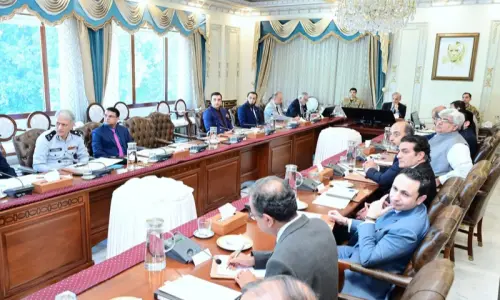
UNITED NATIONS: Pakistani and Indian delegates engaged in a sharp verbal duel at the United Nations on Friday night after Prime Minister Shehbaz Sharif drew the world’s attention to India’s policy of brutal coercion and oppression in held Kashmir.
The Indian delegate, Bhavika Mangalanandan, reacted to the prime minister’s hard-hitting speech at the UN General Assembly in which he referred to New Delhi’s threats and arms build-up. He warned that Islamabad would respond “most decisively” to any aggression by India.
Ms Mangalanandan, first secretary in the Indian Mission to the UN, claimed that Jammu and Kashmir was India’s internal matter and accused Pakistan of “cross-border terrorism”.
She also commented on Pakistan’s domestic matters.
Exercising his right of reply, Pakistani delegate Muhammad Faheem dismissed his Indian counterpart’s false narrative, asserting that Jammu and Kashmir is an internationally-recognised disputed territory.
“It has never been, nor will ever be, a part of India, nor is it an internal matter,” Mr Faheem said.
“Yet, instead of honouring its obligations, India has chosen the path of repression, subjecting the legitimate aspirations of the Kashmiri people for self-determination through a brutal and oppressive occupation,” Mr Faheem, third secretary in the Pakistan Mission to the UN, said.
“India’s illegal and unilateral actions of Aug 5, 2019, further intensified this occupation, with nearly one million soldiers deployed to suppress the Kashmiris’ legitimate aspirations,” he added.
India’s crimes in held Kashmir are “heinous and committed with impunity”, with innocent civilians targeted through staged encounters, extrajudicial killings, and collective punishment, the Pakistani delegate added.
“Entire villages have been razed, the entire Kashmiri political leadership remains incarcerated, and a media blackout continues to stifle independent voices,” the Pakistani delegate said.
The UN High Commissioner for Human Rights and a number of special rapporteurs have documented these widespread violations, calling for the investigation of human rights violations in India-occupied Kashmir, he pointed out.
Rejecting the Indian delegate’s allegations of terrorism, Mr Faheem said: “It is ironic that a country which uses terrorism as an instrument of state policy, should attempt to point fingers at others.”
“India, which has been sponsoring terrorism and orchestrating assassination campaigns worldwide, is hardly in a position to lecture others on the issue.”
Published in Dawn, September 29th, 2024