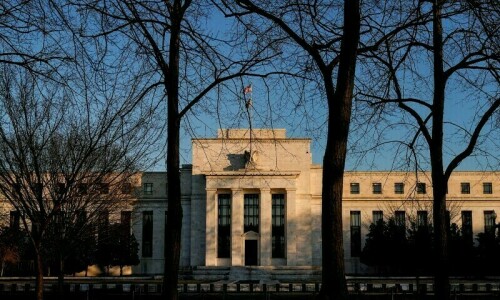
The United States Federal Reserve (Fed) slashed its benchmark interest rates by a “bumper” half of a percentage point last week, kicking off the globally anticipated easing of monetary policy amid growing unease about the “health of the job market”.
This marks the first policy reversal in four years after 11 interest rate increases to the 5.25-5.5 per cent range between March 2022 and July last year.
A Reuters report said policymakers see the Fed’s main rate falling by another half of a percentage point by the end of this year, a full percentage point in 2025, and by a half of a percentage point in 2026 to end in the 2.75-3pc range.
Though the rate cut aims to stimulate the US economy and inflation closer to the Fed’s target of 2pc, it will also have ramifications for the rest of the world as the Fed policy can have an impact on financial markets by affecting currency exchange rates, global interest rates and international flows of investment money.
US policy rate cut to achieve a soft landing is seen as panic-driven with an eagerness to fight a downturn yet to occur
For starters, it will create greater room for other economies, especially in Asia, to carry out monetary easing policies and boost growth. Besides, for most countries like Pakistan, America is an important export market. If the rate reduction leads to more consumer spending in the US, it will buy more stuff from abroad.
Moreover, the Fed’s rate cut makes the dollar lose value against other currencies, costing countries less in their domestic currency to buy dollar-priced commodities like oil. Furthermore, it results in a loosening of global liquidity and may herald the return of the so-called hot money to markets, flowing into equities and bonds.
“The Fed’s rate cut will not have any direct impact on Pakistan,” says Asif Ali Qureshi, the former chief executive officer at Optimus Capital Management. He is not optimistic about Pakistani exports to the US increasing. But, he thinks that it might help Pakistan get better pricing when it taps the international markets to raise the planned fresh debt to shore up its foreign exchange reserves if the International Monetary Fund executive board approves the new $7 billion funding programme this week.
Even though the US economy so far has averted a potential recession as inflation drops to 2.5pc from a mid-2022 peak of over 9pc and the unemployment rate — despite its recent rise to 4.2pc from 3.7pc — is still low by historical standards, the jumbo rate cut has nevertheless triggered a debate among US economists and analysts on the Federal Reserve’s unexpected aggressive easing. Many argue that it suggests the Fed is “concerned about the prospects of a weakening economy after more than a year of holding rates at a 23-year high”.
The Fed has cut rates to support the job market and achieve a “soft landing” — curb inflation without tipping the economy into a steep recession and causing unemployment to surge — though many say it’s not clear if the Fed can pull it off.
Even though inflation “remains somewhat elevated”, the Fed statement noted policymakers chose to cut the overnight rate “in the light of the progress on inflation and the balance of risks”.
The rate reduction might allow Pakistan access to loans at better rates as well as increase exports to the US as consumer spending rises
Senior American Institute for Economic Research fellow Richard M Salsman, who is also president of InterMarket Forecasting, Inc., wrote: “If this is the Fed’s coming move — cutting its policy rate substantially and quickly — it suggests a panicky policy; it betrays both a fearfulness and an eagerness to fight a recession which the Fed itself helped instigate by its previous, excessive, curve-inverting rate hikes.” He noted that “Rate cuts based on hindsight instead of foresight can confirm a recession but can’t prevent it.”
A Bloomberg report observed, “Inflation has cooled considerably and is nearing the Fed’s 2pc target. And while the labour market has weakened, there’s no clear indication the US economy is in recession or on the cusp of falling into one. Layoffs remain low, consumers are still spending, and economic growth is strong.”
An American publication, The Kobeissi Letter, posted on X that something doesn’t add up, “This is only the third time in recent history that the Fed has started rate cuts with a 50 basis points cut. The previous two times, in 2001 and 2007, the economy crashed. In 2001, the market fell 31pc after two years and in 2007 the market fell 26pc after two years.”
Both of these periods were during a recession, which the Fed claims they can avoid this time, it observed. “Meanwhile, interest rate cut futures are trading as though we are heading into a recession.”
The Fed officials, however, said they’re increasingly confident inflation is headed back to normal, so their attention is turning to the risks to the job market.
“We know that it is time to recalibrate our [interest rate] policy to something that’s more appropriate given the progress on inflation,” Fed Chairman Jerome Powell said in a news conference.
“We’re not saying, ‘mission accomplished’, but I have to say, we’re encouraged by the progress that we have made. The US economy is in a good place and our decision today is designed to keep it there,” he added.
Published in Dawn, The Business and Finance Weekly, September 23rd, 2024