0
0

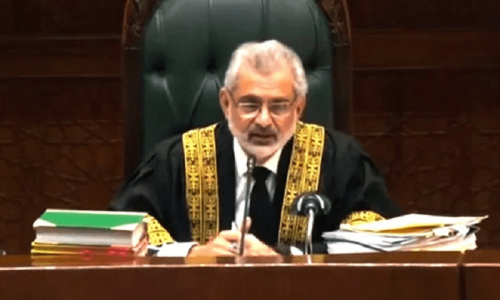
ISLAMABAD: The change in the composition of the three-judge committee after the promulgation of an ordinance that gave wide powers to Chief Justice of Pakistan (CJP) Qazi Faez Isa resurrected the concept of the ‘master of the roster’.
The above-mentioned term was coined by Justice Munib Akhtar last year in a 43-page judgement to settle a controversy about the Punjab and Khyber Pakhtunkhwa elections. Justice Munib had held that former CJP Umar Ata Bandial constituted and reconstituted the benches as ‘master of the roster’.
Through its Feb 27 order, former CJP Bandial had split the nine-judge bench into a five-member bench to continue hearing a suo motu proceeding regarding the delay in the election dates for the provincial assemblies of Punjab and KP.
Soon after the government promulgated the Supreme Court (Practice and Procedure) Amendment Ordinance 2024 on Friday, CJP Qazi Faez Isa changed the composition of the three-judge committee by substituting Justice Aminuddin Khan, the fourth in the line of seniority, for Justice Munib Akhtar.
PBC, SCBA oppose amendment to Practice and Procedure Act, term it detrimental to the Constitution
Under the previous version of the law, the three-judge body that deals with cases under Article 184(3) of the Constitution was supposed to consist of the three senior-most judges i.e. CJP Isa, Justice Syed Mansoor Ali Shah and Justice Munib Akhtar.
With the promulgation of the new law, legal observers believe, the authority to determine the composition of the bench to hear petitions moved under Article 184(3) of the Constitution has again been reverted. During the meetings of the previous committee, the CJP had seemed to be in the minority. Thus the concept of master of the roster — an authority enjoyed by the earlier CJPs has been revived.
‘Life of ordinance’
About the life of the ordinance which is only 120 days unless it is promulgated again, a senior counsel explained that no occasion to promulgate the ordinance will occur after its lapse since it is likely that the federal government will be successful in passing the 26th Constitutional Amendment.
The proposed constitutional package is designed to set up a nine-judge Federal Constitutional Court to hear cases moved under Article 184(3) of the Constitution seeking enforcement of fundamental rights or settling disputes between two provincial governments or deciding appeals against the high courts’ rulings involving constitutional interpretations.
Even if the constitutional amendments are not approved, there will be no need to promulgate the ordinance again since the incumbent CJP will have retired by Oct 25.
Bars oppose ordinance
In a statement on Saturday, Supreme Court Bar Association (SCBA) President Muhammad Shahzad Shaukat and Secretary Syed Ali Imran expressed anguish at the promulgation of the ordinance. The statement said the ordinance was a clear defiance of the long-standing struggle of legal fraternity which culminated in the 2023 law.
“We also express our deep concern at the timing and manner in which this ordinance has been issued and the fact that it practically amounts to a repeal of Act 2023 which is unacceptable, particularly when the earlier legislation had already been upheld by the Supreme Court,” the statement said.
It said the SCBA strongly believed that the original act served a pivotal role in strengthening the Supreme Court by enhancing access to justice and upholding the fundamental rights enshrined in the Constitution, thereby ensuring a more equitable and transparent judicial process.
In contrast, the new amendments were detrimental to the Constitution, the independence of judiciary, and the protection of fundamental rights, it said. According to the statement, the association also viewed with grave concern that the sacred institutions like parliament and judiciary are on a collision course if both sides do not exercise restraint for the sake of the system.
The SCBA also called upon all relevant stakeholders to uphold the sanctity of the Constitution, the independence of the judiciary, and the fundamental rights of the people of Pakistan.
Meanwhile, Pakistan Bar Council Farooq Vice Chairman Hamid Naek said the Supreme Court Practice and Procedure Act 2023 was an outcome of the legal fraternity and lawyers’ struggle, who welcomed and appreciated the law.
This recent ordinance was made without consulting the stakeholders or dialogue in parliament, he said, adding that the government should have engaged the PBC before its promulgation. He added the government had shared the draft of the 26th Constitutional Amendment for the PBC’s input.
He said PBC always supported and struggled for the supremacy of the Constitution, the rule of law, and independence of the judiciary. He urged the government to place the ordinance before PBC’s executive committee for their opinion.
Published in Dawn, September 22nd, 2024