PM gives go-ahead for drastic tax enforcement


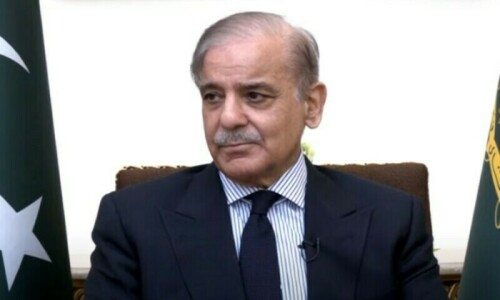
ISLAMABAD: In what looks to be a big move, Prime Minister Shehbaz Sharif has approved drastic measures for tax enforcement and compliance, including a ban on all banking and financial transactions for non-filers of tax returns.
The premier also gave the go-ahead to Federal Board of Revenue (FBR) Chairman Rashid Mahmood Langrial to submit summaries to the federal cabinet to expedite the implementation of the FBR Indigenous Transformation Plan. Mr Rashid and his team briefed the premier on the salient features at the prime minister’s secretariat.
Over 50 tax officers and tax experts worked together to develop the FBR transformation plan over the previous 40 days, focussing on structural challenges that were impeding revenue growth. The plan aims to reduce the amount of cash currency in circulation to a level comparable to peers in the region. Pakistan has 25pc of currency in circulation, Bangladesh and India have 14pc, and Malaysia has over half at 7pc.
The premier was informed that no extra revenue measures will be announced to meet the estimated budgetary target of Rs12.970 trillion in FY25. The additional steps will put the budgetary measures into action and close loopholes, particularly in the under-declaration of income and payments under the income tax.
Restrictions on non-filers
The proposed approach has three tiers based on the amount filed. Non-filers cannot acquire cars, immovable property, or financial instruments or open bank accounts, except the Asaan Account. This will be a major policy move to document the economy.
Non-filers barred from banking transactions, buying property and cars
Those who have claimed an income of more than Rs10 million are eligible for all of these benefits in the first category. However, those who declared an income of less than Rs10m must explain their sources of income while purchasing a car, immovable property, or financial instruments. However, persons in this second category can open bank accounts.
The premier was informed that just 14pc of manufacturers are registered for sales tax, with the remaining 86pc unregistered. The registration outlook for income tax is pretty gloomy. Wholesalers are just 25pc registered for income tax, with the remaining 75pc unregistered, while retailers are only 8pc registered and 92pc unregistered.
The suggested strategy to guarantee documentation included disallowing input on sales to unregistered entities and using digital invoicing to track unregistered purchasers. Notices will be given to unregistered entities, coupled with severe fines for noncompliance. Other recommended measures include restricting utility services and freezing bank accounts and property transactions.
Freezing bank accounts
It was proposed that the bank accounts of unregistered manufacturers, wholesalers, and distributors be frozen, with a yearly turnover of Rs250m. The other planned actions include attaching properties, sealing premises, and a new penalty of Rs1m.
In the case of retailers, the bank accounts of unregistered traders with an annual turnover of Rs100m would be frozen, along with a new penalty of Rs1m.
According to the plan, tax officers would get incentives based on their integrity and output performance. The incentive will be based on 60pc integrity and 40pc performance, and it will be provided to officials every quarter. FBR will create integrity indexes.
According to an official announcement from the prime minister’s office, in the plan’s first phase, “efficient and competent officers” would be stationed in Karachi — the biggest taxpayer unit that accounts for 32pc of total collections — and would be helped by auditors and specialists.
Meanwhile, the prime minister praised the FBR’s restructuring strategy, saying that increased tax collections will improve service delivery and the social sector. He also referred to the taxation power as “the backbone of the national economy”.
The premier directed the FBR to consult prominent taxpayers regarding the plan and seek approval of the amendments in coordination with the government departments for effective implementation. He also directed third-party audits of FBR’s projects and expedited efforts to curb smuggling.
The meeting participants were told that to curb custom duties theft, an appraisal and enforcement mechanism had been devised to assign the task to appraisers and inspectors without their prior knowledge, who would be monitored through cameras, the statement said.
Published in Dawn, September 21st, 2024