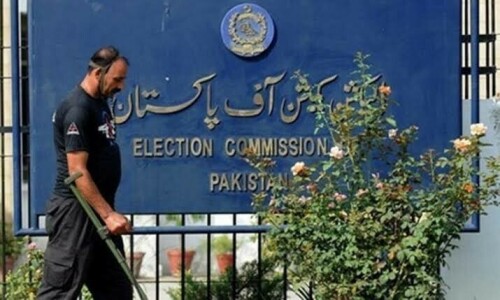
THE Election Commission of Pakistan appears to be in no mood to obey the Supreme Court, and, continuing a pattern observed over the last year, the federal government seems eager to provide it political cover.
It emerged on Wednesday that the ECP would, instead of implementing the Supreme Court’s verdict in the reserved seats case, seek further opinion from ‘legal experts’ on the matter. This, despite being warned by the court not to delay any further.
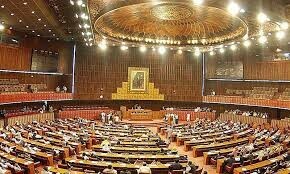
As it turns out, it did not need legal counsel: on Thursday, the National Assembly Speaker himself came to the ECP’s rescue, informing the Commission that since a new law — bulldozed last month through parliament to prevent the reserved seats from being given to the PTI — had come into effect, it need not heed the Supreme Court’s order. Unexpected though the move was, it was not the first time that the ruling set-up had come to the ECP’s aid against the courts.
Last year, the ECP had similarly refused to obey the apex court when it made it clear it would not hold elections to the Punjab Assembly despite what the court ordered. The then-PDM government had endorsed the ECP’s stance, even though it had been in clear violation of the timeline for polls provided in the Constitution. Emboldened, the ECP has continued to thwart the courts since, be it in the matter of election tribunals or, as recently seen, in the case pertaining to the PTI’s reserved seats.
It may be recalled that the Commission’s last attempt to delay implementation of the Supreme Court’s verdict in the reserved seats matter was officially condemned as “dilatory tactics, adopted to delay, defeat and obstruct implementation of the decision of the court”. The ECP was also warned that continuing on this path “may expose the Commission” to legal action in terms of the Constitution and the law. It had zero effect.
Now, the government’s actions could turn this into a major clash between institutions. It is a risky and unfortunate escalation. Any confrontation on this issue is a direct challenge to the separation of powers as envisioned in the Constitution. The incident underlines that, despite its repeated claims to institutional ‘supremacy’ derived from democratic ideals, this government seems to have little interest in, or understanding of, democracy’s core principles.
The fact that it is relying on tailor-made legislation, moved after a court verdict, to thwart its implementation will be seen as defiance against the judicature. The situation is made worse by the Speaker of the National Assembly stepping in and endorsing the Commission’s position.
The separation of powers must be respected and no institution should overstep its bounds. At this critical juncture, all state institutions must remain within their mandates to prevent further erosion of democratic values.
Published in Dawn, September 20th, 2024