TikTok’s US future hangs in balance at federal court


 0
0


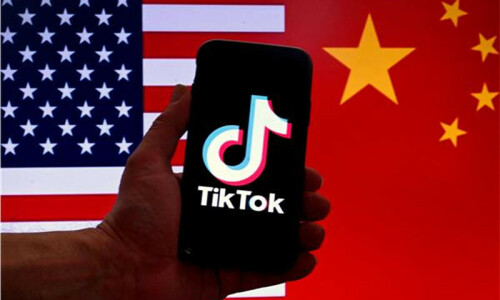
TikTok will attempt to convince a federal court on Monday that a law requiring the video-sharing app to divest from its Chinese ownership or face a ban in the United States is unconstitutional.
The fate of Americans’ access to TikTok has become a prominent issue in the country’s political debate, with Republican presidential candidate Donald Trump opposing any ban of the wildly popular app.
Democratic President Joe Biden, whose vice president Kamala Harris is running against Trump, signed the law that gives TikTok until January to shed its Chinese ownership or be expelled from the US market.
ByteDance, TikTok’s parent company, has stated it has no plans to sell TikTok, leaving the app’s legal appeal — focused on US guarantees for free speech — as its only option for survival.
A ban would likely provoke a strong response from the Chinese government and further strain US-China relations.
A three-judge panel of the US Court of Appeals for the DC Circuit will hear arguments from TikTok, ByteDance, and a group of users.
They will primarily contend that the law violates free speech rights.
The judges will decide the case in the coming weeks or months, but regardless of their decision, the case is likely to reach the US Supreme Court.
“There is no question: the Act will force a shutdown of TikTok by January 19, 2025,” TikTok’s appeal stated, “silencing those who use the platform to communicate in ways that cannot be replicated elsewhere.”
TikTok also argued that even if divestiture were possible, the app “would still be reduced to a shell of its former self, stripped of the innovative and expressive technology that tailors content to each user.”
TikTok asserts that “the Constitution is on our side,” as it pushes for a ruling that would favor the app and its 170 million American users.
The US government counters that the law addresses national security concerns, not speech, and that ByteDance cannot claim First Amendment rights in the United States.
“Given TikTok’s broad reach within the United States, the capacity for China to use TikTok’s features to achieve its overarching objective to undermine American interests creates a national-security threat of immense depth and scale,” the US Justice Department wrote in its filing.
The US argues that ByteDance could and would comply with Chinese government demands for data about US users, or yield to Chinese government pressure to censor or promote content on the platform.
‘Vote for Trump’
TikTok first faced scrutiny under former president Trump’s administration, which tried unsuccessfully to ban it.
That effort was halted when a federal judge temporarily blocked Trump’s move, citing in part the potential infringement of free speech rights. Trump has since changed his position.
“For all of those that want to save TikTok in America, vote for Trump,” he said in a video post last week.
In a measure of the app’s popularity, Biden’s reelection campaign created a TikTok account earlier this year.
Biden has since stepped aside from his reelection bid, but Harris, running in his place, also maintains a presence on the app, having embraced social media as a means to communicate with younger voters.
The new effort signed by Biden was designed to overcome the previous legal hurdles Trump faced, but some experts believe the US Supreme Court will have difficulty allowing national security considerations to outweigh free speech protections.
Much of the US side’s national security arguments are sealed, which “complicates efforts to evaluate” them, said professor Carl Tobias of the University of Richmond School of Law.
“However, the US Supreme Court has generally been very cautious about accepting national security arguments when government regulation restricts First Amendment rights, especially involving the internet,” he added.