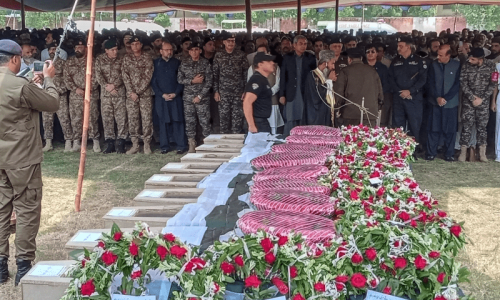
THE brazen attack in Rahim Yar Khan a few days back, in which 12 police officers lost their lives, brought to mind the proverb, “If you want to get rid of mosquitoes, drain the swamp that breeds them”.
The katcha areas, ie the riverine areas of south Punjab and upper Sindh, have become a perennial headache. The frequency of attacks and magnitude of losses have multiplied recently. However, the state response to this complex ‘cancer’ has so far been to treat it with ‘aspirin’.
The riverine area in Pakistan lies where the borders of Sindh, Balochistan and Punjab meet. This tri-border area is of strategic importance because the Koh-i-Sulaiman hump has pushed all railroads, gas and oil pipelines, rivers and motorways to converge in a narrow geographical corridor that passes through it. To understand the complexity of criminality in this strategic terrain, let’s delve deeper into the issue.
Generally, weak governance and security gaps in tri-border areas allow criminal infestation. For example, criminal gangs threaten shipping lanes in the tri-border areas of Indonesia, the Philippines and Brunei. Likewise, the Liptako Gourma tri-junction of Mali, Burkina Faso and Niger has become the epicentre of militant attacks. Similarly, Tres Fronteras, or the triple border of Brazil, Colombia and Peru, is a hotbed of illicit activity, including narco-trafficking, deforestation and organised crime networks.
Since the three provinces of Sindh, Punjab and Balochistan have different governments with different priorities, there is a lack of synergy in their efforts against criminal elements. Additionally, the criminals follow a peristaltic movement: when pressure is exerted through kinetic operations in one province, they displace to and disperse in another. Secondly, in the riverine terrain, ‘crimes and cusecs’ are directly related. When the water level, ie cusecs, rise in the mighty Indus, especially in the monsoon season, there is a spike in criminality and dacoits dominate the terrain due to the restricted mobility of LEAs.
Thirdly, sugarcane sown in Rahim Yar Khan yields the highest sugar content, which leads to extensive cropping. This area provides camouflage to dacoits in the November-January period, when water starts receding in the Indus.
Since Sindh, Punjab and Balochistan have different governments, there is a lack of synergy in their efforts against criminals.
Fourthly, there are geographical enclaves of one district or province in another district or province, which makes operations against criminals difficult. Rajanpur lies west of the Indus, but its enclave, Bangla-Icha, is located to the east of the Indus in Rahim Yar Khan district. Bangla-Icha has historically proved to be the Waterloo for our police, with maximum casualties occurring there because reserves from Rajanpur police take five hours to reach Bangla-Icha in case of a crisis, while the RYK police hardly require half an hour. Likewise, Machka, the site of the recent attack, is a geographical enclave of Punjab located within Sindh, where police from Sindh can be more effective and responsive.
Fifthly, criminal franchises flourish in regions where economic disparities are highest. Districts with highest economic disparities and lowest HDI, like Rajanpur, Ghotki, Kashmore, Dadu, etc, are incubators for criminal gangs. Finally, the political economy plays an important role. In some areas, dacoits are the antidote to the bourgeois feudal system, and in other places, waderas use the patronage of these bandits for political mileage. Fake police encounters involving the innocent relatives of the dacoits alienate the youth and swell the ranks of criminals.
To bring stability in the tri-border region, a long-term, proactive approach is required, involving both kinetic and non-kinetic actions. Firstly, the three provinces need unity of effort and pooling of forces to minimise coordination deficit. A simultaneous and coordinated hammer-anvil strategy employed by the three provinces can squeeze the criminal networks. Secondly, administrative-legal decisions are required to merge the enclaves in respective districts or provinces. An inter-provincial task force can be formed to take structural decisions regarding these geographical anomalies. In 2017-18, the Punjab government merged the Rajanpur enclave of Bangla-Icha in Rahim Yar Khan district. Criminal activities drastically declined after that decision. However, the decision was reversed under feudal pressure.
Thirdly, the LEAs need to be equipped with superior weaponry and gadgetry as compared to the criminals. The dacoits have 12.7mm anti-aircraft guns, 81mm mortars, RPGs and anti-tank mines, which not only hinders police mobility but also make the police APCs sitting ducks. In such a threatening environment, police need amphibious capabilities and vertical-aerial gadgetry in the form of VTOL drones, surveillance drones with night-time capability, thermal-imaging scopes for guns, and simple armed drones that can drop mortars under gravity.
Moreover, incentivising criminal arrests through reward money and activating passport control at airports and an IVAS system at borders will lead to their attrition.
Fourthly, halting the conversion of cotton belts to sugarcane belts, especially near the riverbeds, will expose criminals’ movements. Fifthly, the no-go areas can be integrated with the mainland through infrastructure development. Bridges can help mainstream fractured social strata. Such infrastructure will reduce under-governed blind spots. Sixthly, establishing a truth and reconciliation commission will help resolve protracted tribal feuds and give relief to innocent citizens wrongly nominated in FIRs. Finally, the marginalised areas need to be integrated into the mainland through better education and employment opportunities.
In 2018, a community school was opened in the riverine area of Rojhan at a meagre cost of Rs200,000. Children of dacoits were admitted in this school. It became an instant success because of free lunch and free books provided to these children. A notorious bandit, Attaullah Putt, once dining with his grandchildren studying in the said school, appreciated the system as the children had learnt English words which he couldn’t understand. He was surprised when his grandchildren showed eagerness to attend this school even on Sundays!
Therefore, for long-term stabilisation, the pen should replace the Kalashnikov in youth’s hands. Draining the swamp is more effective than the short-term strategy of focusing on mosquitoes.
The writer has conducted research on the katcha areas.
Published in Dawn, September 6th, 2024