Showman sprinter Noah Lyles wins 100m gold by five thousandths of a second


 0
0


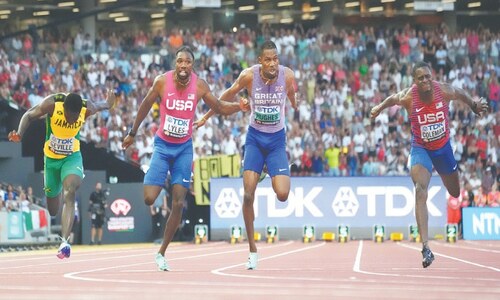
After all the talk and all the hype, Noah Lyles duly delivered when it mattered most by winning the closest-ever Olympic 100 metres final by five thousandths of a second on Sunday to give the United States the title for the first time in 20 years.
In a blanket finish Lyles believed he had left it too late to catch the powerful Kishane Thompson, but the giant screen confirmed him as the winner in a personal best 9.79 seconds, the same time as the Jamaican, but ahead by the width of a vest.
If the race had been 99 metres, Thompson would have been celebrating a fourth Jamaican men’s 100m win in five Olympics, but fast-finishing Lyles kept his form superbly and timed his dip expertly to add Olympic gold to his world title.
He ripped his name bib from his shirt and held it aloft with his red, white and blue varnished fingernails, announcing himself, as he had always promised he would be, as the fastest man in the world.
“It’s the one I wanted, it’s the hard battle, it’s the amazing opponents,” said Lyles, the first American male Olympic 100m champion since Justin Gatlin in 2004.
“I didnt do this against a slow field, I did this against the best of the best, on the biggest stage, with the biggest pressure.”
He was right about that, as it was the first time eight men have broken 10 seconds in a wind-legal 100 metres race.
American Fred Kerley took bronze in 9.81 and Akani Simbini of South Africa was fourth, making it a remarkable six fourth or fifth-placed finishes in global championships, albeit with the consolation of a national record time of 9.83.
Defending champion Lamont Marcell Jacobs of Italy, heavily strapped, finished fifth in 9.85 and Letsile Tebogo of Botswana also set a national record with 9.86 in sixth.
Such was the quality of the race, that eighth-placed Oblique Seville of Jamaica clocked 9.91 seconds.
“I did not think I won, I didn’t think I dipped at the right time, too early,” Lyles said. “I even went up to Kishane while we were waiting and said ‘I think you got that one.’ But then my name popped up and I thought ‘oh my gosh, I’m amazing’.”
Thompson disappointed
Thompson arrived in Paris as the fastest man in the world this year (9.77) and was the quickest of the semi-finalists on Sunday with 9.80.
“I am a bit disappointed, but I am happy at the same time,” he said. “I wasnt patient enough with myself to let my speed bring me at the line in the position that I know I could have gone to.”
Former world champion Kerley also ran an excellent race to add bronze to his Tokyo silver.
“That was a great race and anyone could have won it,” he said.
“I feel that I executed as best as I could. I came here for the gold and nothing else but, hey, everybody came here for the same thing and only one can win. Whoever came off the best, is the best.”
Seville had finished ahead of Lyles in the semi-final when the American looked to be at full stretch.
However, the biggest showman in the sport and the star of the runaway success Netflix SPRINT series, has become a serious championship operator over the shorter distance, having won three 200m world titles and 200m bronze at the last Olympics.
“I think back to Tokyo when I messed up handling the rounds. From then on, I was like, ‘I’m never going to do that again. I’m going to handle this correctly and practise over the years’,” he said, adding that he felt rattled after the semi and called one of his therapists for advice.
Lyles, 27, is targeting a possible four golds in Paris, in the 100m, his favourite 200m, the 4x100m relay and, possibly, the 4x400m relay.
That would emulate illustrious compatriots Jesse Owens and Carl Lewis, who achieved the feat at a single Games but with long jump instead of the longer relay.