“I COMPLETELY empathise and sympathise [with the people],” remarked Pakistan’s finance minister as the tax-loaded Finance Bill 2024 was passed by the National Assembly. In a country where more than 10 million children are suffering from undernutrition, the finance minister was keen to observe that Pakistan is “making positive progress” before imposing a ‘milk tax’ on infant formula.
Such remarks beg the question what does the finance minister even mean by the word ‘progress’? Is the imposition of exorbitant taxes a way of empathising with the people? To answer such questions, one has to understand the kind of people who become finance ministers in Pakistan in terms of their academic and professional credentials as well as their socioeconomic background. It is through examining these that one can understand their worldview.
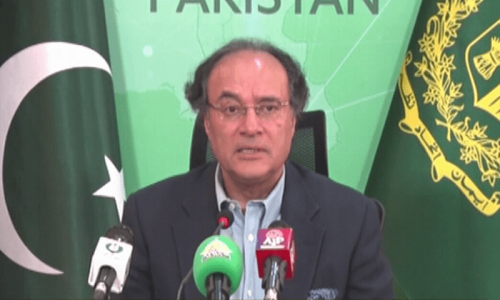
Pakistan’s current finance minister, Muhammad Aurangzeb, studied at Aitchison and graduated with a Bachelor’s degree and an MBA from the University of Pennsylvania. He began his banking career at Citibank and later joined ABN AMRO and RBS International and led their businesses in multiple countries. Subsequently, he became a chief executive at JP Morgan and then president and CEO of HBL prior to becoming finance minister in March 2024. During his time at HBL, he was one of the highest-paid CEOs in Pakistan with a monthly salary of approximately three crore rupees.
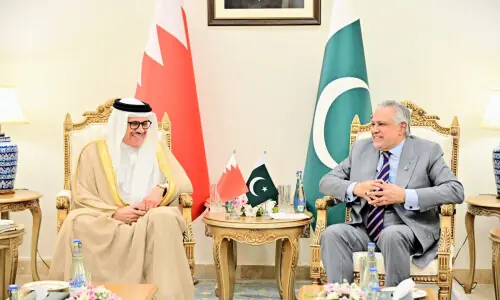
However, he is not the only finance minister whose professional experiences mostly included working in executive positions. He was preceded by finance minister Ishaq Dar, who had a similar background though more oriented towards public institutions. Dar graduated with a Bachelor’s degree from the University of Punjab and subsequently became a chartered accountant.
Have our FMs understood the common man’s pain?
Dar’s professional experiences included stints as director of finance at British Textiles Group, a senior auditor in the government of Libya, and a partner of a Pakistan-based chartered accountants’ firm. Additionally, he was director at numerous multilateral organisations including the World Bank and the Asian Development Bank. Though he had graduated from a domestic university, his career mostly comprised working in executive positions abroad. He became Pakistan’s finance minister after Miftah Ismail resigned from the position.
Miftah Ismail holds a Bachelor’s degree from Duquesne University along with a doctorate from the University of Pennsylvania. He initially worked as an economist with the IMF but then returned to Pakistan to work for his family’s business — Ismail Industries Limited, which is one of the country’s largest confectionary and snack food manufacturers.
This trend of appointing people from elite backgrounds to the post of Pakistan’s minister of finance goes back even further. Asad Umar had an MBA from IBA Karachi and was the former CEO of Engro Corporation. Abdul Hafeez Shaikh had undergraduate and graduate degrees from Boston University and was the World Bank country head in Saudi Arabia. Shaukat Tarin, too, had an MBA from the University of Punjab and a career in banking, with the names of Citibank and Habib Bank Limited on his resumé.
The question is whether such finance ministers with elite backgrounds realise what implication their economic policies have for the people of this country. At the end of the day, the decision to impose a milk tax is as much about making infant formula inaccessible to millions of impoverished babies in the country as it is about improving the country’s revenues. While an increase in taxes may not have implications for someone who earned Rs3 crore per month, it definitely does for someone who has to work two jobs just to sustain their family.
A banker, accountant, or economist might analyse Pakistan’s economic instability simply as a matter of manipulating numbers on an Excel sheet but for the common person, it is a matter of their standard of living.
The intention here is to neither question the professional acumen of these finance ministers nor argue that somehow having a finance minister from a non-elite background would automatically resolve Pakistan’s economic issues. Instead, the aim is to analyse the analytical framework through which these finance ministers analyse Pakistan’s economy and their blind spots due to their own elite background.
Only when we have finance ministers who understand as well as relate to the implications their economic policies have for the common people, can we bridge the feeling of alienation in the people of Pakistan. Only then can we understand what the word ‘progress’ means — not to the elite, but the ordinary people of this country.
The writer is a research associate at Shaikh Ahmad Hassan School of Law at the Lahore University of Management Sciences.
Published in Dawn, July 31st, 2024