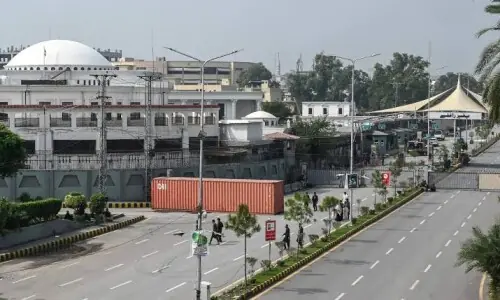
HYDERABAD: A pent-up frustration among electricity consumers is growing as the Hyderabad Electric Supply Company (Hesco) continues to charge detection units (or suspected electricity theft), quite unjustifiably in most cases.
Hesco, according to information, charged 40m units more in the month of June alone this year when compared with corresponding month last year in terms of theft detection.
The per unit cost given effect since June 2023 is Rs6.90 and by charging the 40 million more units in June, Hesco aimed at generating Rs276 million in recoveries from consumers, though with a massive anomaly.
It is on this account that Hesco is among those distribution companies that are facing a Nepra (National Electric Power Regulatory Authority) over issuance of unusually higher detection bills in the month of June this year.
Hesco chief Roshan Otho neither attended phone calls nor did he reply the Whatsapp messages sent to him over the last few days for his comment. Such message was also conveyed to Hesco spokesman Sadiq Kubar but he also did not get back. He had only this to offer: “Insofar as this inquiry [on detection issue] is concerned, it pertains to all distribution companies and not Hesco alone”.
The spokesman was told that Hesco chief’s view was to be incorporated in the news report which pertained to this particular power utility, and not all distribution companies.
A Nepra source while talking to Dawn over phone said: “The inquiry [by Nepra] will soon be completed.”
“Hesco is a failed power utility as a company,” he quipped, and said detection/units charged in June 2024 were quite higher whilst recovery against receivable amount of these units was just negligible.
According to Nepra source, Hesco has charged 132m units against consumers which puts receivable amount at Rs3.2bn. “The recovery against this amount is Rs140m or 4pc. This shows these units are not fairly charged,” he said. The utility charged these units against 185,000 consumers.
Sharing figures of June 2023, the source said that Hesco had charged 94m units against 155,000 consumers with a cumulative receivable amount of Rs1.74bn. “But the recovery remains at Rs104m, or 6pc,” he pointed out.
According to one Hesco source, comparative analysis of June 2023 and June 2024 shows, that 40m more units were charged this year when compared with corresponding month of 2023. “It is differential of 94m units and 132m units,” the source said. He explained that per unit cost in June 2024 was Rs25.20 against Rs18.90 in June 2023, showing an upward difference of Rs6.90 in terms of raise in tariff. Its monetary impact would be severe when multiplied by 40m units charged more in June this year. “So it means consumers are required to pay more simply for these detections,” he added. Likewise, more consumers were charged detection units.
The Nepra source added that Hesco always would report higher line losses which were usually 37pc and the burden of line losses, i.e. around 12pc, was borne by consumers and 18pc became part of circular debt.
“Since the receivable amount is quite less than what was charged through detection, this proves that detection units were unjustifiably charged to overcome line losses,” he said.
Hesco claims it has to recover Rs209.34bn from its consumers in the region. Hesco spokesman in his July 23 announcement claimed that so far 81,434 connections were detected in anti-power theft campaign and letters for registration of FIRs of electricity theft were submitted against 72,093 connections. He said that 5,285 FIRs had been lodged so far.
Frustration continues to grow among consumers. They are giving vent to their anger in their social media messages.
Sepco, similarly, charged 150m units in June 2024 with a cumulative receivable of Rs5.7bn but recovery remained Rs300m which was 5pc-5.5pc. In June 2023, Sepco had charged 141m units against 190,000 consumers to recover Rs3.9bn. But Rs30m could be recovered which was 0.7pc of receivables.
Published in Dawn, July 29th, 2024