KARACHI: The city administration does not seem prepared to tackle issues like flooding during monsoon, heatwaves, tree felling and influx of population and, therefore, there is a need to rethink the entire master plan for Karachi to make it a liveable city.
These were the views of speakers at a programme — Safe Karachi Conference: Strengthening Urban Resilience —organised at the Institute of Business Administration’s City Campus on Thursday.
The conference brought together speakers from various fields and government departments to discuss their vision for a safer and sustainable Karachi and its preparedness for disasters.
In one of the panel discussions, speakers focused on urban flooding and heatwave related risk preparedness and the shared responsibility of the government and citizens.
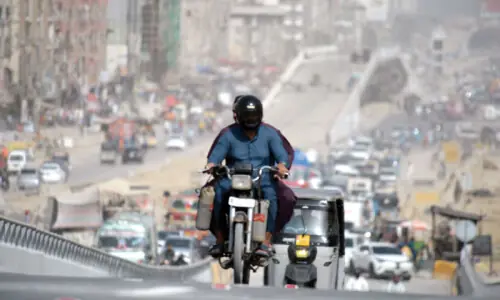
Journalist and environment activist Afia Salam while speaking of the unusually harsh weather the city has been experiencing for the past many weeks said there was a difference between a hot day and a heatwave. A heatwave, she said, was that in which the temperature remained higher than the normal for around a week.
And when a heatwave was going on, she said, people in Karachi often used wrong methods to tackle it. Using chilled water and sprays, which people used in heatwaves, were never advised by experts, she said and added that the right thing was to cover one’s head, preferably with a wet piece of cloth.
Speaking of the ‘mater plans’ made to solve various issues of the city, she said seven such plans were made but none was implemented. Similarly, a heatwave management plan was also made in 2015 but it was not implemented.
She also spoke of other issues related to urban planning and flooding, saying that urban forest policy should be implemented and public parks should be developed to mitigate the effects of heatwave.
Besides all those, a “total rethinking” was needed on part of the city administration to resolve all such problems, she added.
Soha Macktoom, associate director at the Karachi Urban Lab, said the city was vulnerable to two main disasters: urban flooding and heatwave. She said that at present the city was not resilient to the disasters it was facing.
Katchi abadis, she said, were often blamed for encroachments but many commercial properties and government institutions were also doing the same, even affecting storm water drains.
She also stressed on identifying and studying particular needs for Karachi and its different areas instead of just copying solutions from other cities and introduce all those in the city’s master plan.
Zubair Ahmed Channa, the director of the Solid Waste Emergency & Efficiency Project (SWEEP), spoke about efforts to improve the drainage system in the city.
Imdad Hussain, manager operations of the Provincial Disaster Management Authority, said a survey had been conducted for disaster response in all district of the province. He said efforts were being made to strengthen the collaboration with district disaster management authority.
The speakers also said that not planting trees in the city and cutting down those already existed was also contributing greatly to hot weather and the government did not seem to be much concerned about that.
Similarly, they were of the view that other cities and towns should be developed to decrease influx of people in Karachi and unless that was done, no plan would be affective to resolve the city’s problems.
During the conference, the Alertli app was also launched. It aims to report safety hazards, including encroachments.
Published in Dawn, July 26th, 2024