ISLAMABAD: As the Judicial Commission of Pakistan (JCP) is meeting on July 2 to consider nomination of three judges to become the Chief Justice of the Lahore High Court (LHC), six members of the Pakistan Bar Council have expressed the hope that the commission will adhere to the principle of seniority to promote credibility of the judicial system in the country.
“We hope that in the case of the appointment of chief justice in the LHC, seniority principle will be adhered to promote credibility of the judiciary system in the country,” said a letter addressed to Chief Justice of Pakistan (CJP) Qazi Faez Isa, written by PBC members Shafqat Mehmood Chohan, Abid Shahib Zuberi, Ch Ishtiaq Khan, Munir Ahmad Kakar, Shahab Sarki and Tahir Faraz Abbasi.
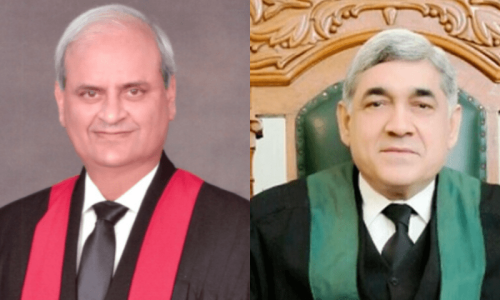
On July 2, the JCP will consider the nomination of Acting Chief Justice Shujaat Ali Khan, Justice Ali Baqar Najafi and Justice Aalia Neelum to become the next chief justice of the high court.
The office of the chief justice of LHC became vacant after the elevation of Justice Malik Shahzad Ahmad Khan to the Supreme Court on June 7.
In their letter, the PBC members said that the principle of seniority has long been a cornerstone for ensuring integrity, fairness and predictability of judicial appointments. Any departure from it could have serious implications for the judiciary’s credibility and independence.
The principle of seniority is not merely a matter of tradition, but a fundamental tenet that reinforces the meritocratic and hierarchical structure of our judicial system, the letter said.
It, however, expressed concern over reports that this principle might be overlooked. If the senior-most judge of the high court is deemed unfit for the role of the chief justice, it raises a significant question about his capability to serve as the judge of the high court at all, it said.
Therefore, any such deviation needs to be substantiated with substantial and material evidence, the letter said, adding that in the interest of maintaining transparency and upholding public trust in the judicial system, the principle of seniority needs to be followed.
“If there are any specific reasons or disabilities pertaining to the senior-most judge that preclude his appointment as the chief justice, these should be communicated transparently with necessary material evidence,” the letter said, adding that the credibility and integrity of a judge were paramount, as these qualities were foundational to maintain the trust and confidence of the public in the judicial system.
Published in Dawn, June 29th, 2024