Russia could reduce decision time for use of nuclear weapons: lawmaker


 0
0


MOSCOW: Russia, the world’s biggest nuclear power, could reduce the decision-making time stipulated in official policy for the use of nuclear weapons if Moscow believes that threats are increasing, parliament’s defence committee chairman said.
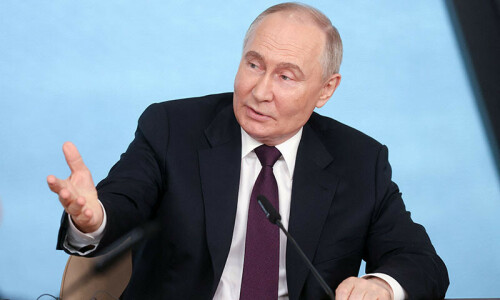
The war in Ukraine has triggered the biggest confrontation between Russia and the West since the 1962 Cuban Missile Crisis, with President Vladimir Putin last month saying that Russia might change its official nuclear doctrine setting out the conditions under which such weapons could be used.
On Sunday Andrei Kartapolov, the head of the Russian lower house of parliament’s defence committee, was quoted by state news agency RIA as saying that if threats increased then the decision-making time for using such weapons could be changed.
“If we see that the challenges and threats increase, it means that we can correct something in (the doctrine) regarding the timing of the use of nuclear weapons and the decision to make this use,” RIA quoted Kartapolov as saying.
Hardliners believe Putin should be able to act more swiftly on nuclear escalation and reduce threshold for use
Kartapolov, who once commanded Russian forces in Syria and now serves as a lawmaker from the ruling United Russia party, added that it was too early to speak about specific changes to the nuclear doctrine.
Russia’s 2020 nuclear doctrine sets out when its president would consider using a nuclear weapon: broadly as a response to an attack using nuclear or other weapons of mass destruction or conventional weapons “when the very existence of the state is put under threat”.
Pressure from hardliners
But he also said he did not rule out changes to Russia’s nuclear doctrine. The was viewed as a nod to pressure from hardliners in the Russian elite who believe that Putin should be able to act more swiftly on nuclear escalation and reduce the threshold for use.
Putin said again last week that the nuclear doctrine might have to be changed because Russia’s adversaries were developing ultra-low-yield nuclear devices.
Both Moscow and Washington made heavy cuts to the number of their weapons as the Soviet Union crumbled, but the Cold War arms control architecture has crumbled and many diplomats say they now fear a new arms race.
The United States may have to deploy more strategic nuclear weapons in coming years to deter growing threats from Russia, China and other adversaries, a senior White House aide said this month.
Russia says it is interested in discussing arms control with the United States, but only as part of a broader discussion involving European security and the future of Ukraine.
The US 2022 Nuclear Posture Review says that Russia and China are both developing their nuclear arsenals so that by the 2030s “the United States will, for the first time in its history, face two major nuclear powers as strategic competitors and potential adversaries”.
Russia and the United States are by far the world’s biggest nuclear powers, holding about 88 per cent of the world’s nuclear weapons, according to the Federation of American Scientists.
Published in Dawn, June 24th, 2024