0
0

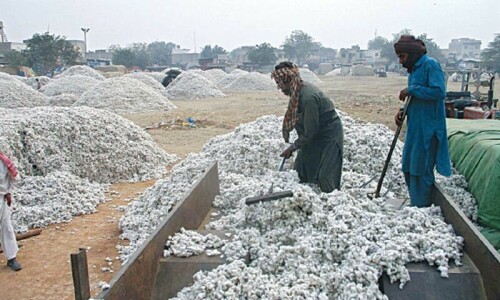
LAHORE: Cotton ginners across the country have gone on an indefinite strike to protest against new taxes and an “exorbitant” rise in the power tariff for ginning units.
A general body meeting of the Pakistan Cotton Ginners Association (PCGA) held in Sukkur on Sunday decided to immediately suspend the procurement of raw cotton and delivery of the ginned lint to spinning units across the country as a protest.
“Cotton ginners are already paying 11 different types of taxes due to which they are suffering from severe financial hardship,” said PCGA chairman Chaudhry Waheed Arshad, adding that it was not possible “for us to continue the ginning business” any more.
While speaking to hundreds of ginners who had gathered from across the country, Mr Arshad announced the “unanimous” decision to stop the purchase of raw cotton immediately.
Procurement of new cotton crop, supply of lint to factories will also be halted in protest
He added that neither white lint will be delivered to textile mills nor any new cotton sale agreement will be signed until PCGA’s demands are accepted.
He said the government would be responsible for the impact of strike on cotton growers, ginning and textile sector as well as cotton exports.
Cotton Ginners Forum chairman Ihsanul Haq claimed that 72 per cent general sales tax (GST) is already imposed on the ginning sector and the PCGA has repeatedly requested the government to reduce it.
He regretted that an additional 10pc GST on the sale of oil cake — coarse residue obtained after oil is removed from various oilseeds — has been proposed in the budget presented by the finance minister earlier this month.
Authorities have been repeatedly approached to reduce the burden of taxes on the ginning sector as many units have already been shut due to excessive taxation, he claimed.
This taxation is giving rise to undocumented business, Mr Haq claimed, reiterating the ginners’ plea for “a much-needed breather for the sector”.
The electricity charges for ginning factories have been fixed at Rs2,000 per kilowatt hour, which means that a factory would have to pay at least Rs600,000 per month even if it was lying closed.
The strike will deal a fresh blow to cotton growers, who are already shifting to alternative crops due to higher production costs, poor yield and low rates for their produce.
The halt in raw cotton purchase will not only hit the market adversely, but also delay payments to farmers which they need to pay off debts and invest in farm input for the next crop.
Market observers believe that a 15-day strike would drop the raw cotton rate by at least Rs1,000 per 40kg. Presently, the rate is around Rs9,500 per 40kg.
The delay will also damage the crop as farmers are not adept in safe storage techniques. This will impact the lint quality whether stored indoor or in the open. In a store house, the seeds will lose oil content, while in the open they will be at the mercy of heat and rain.
Published in Dawn, June 24th, 2024